Have you ever kicked the blanket off because it’s too warm… only to pull it right back up five minutes later?
Or is that just me?
I love to be covered with a blanket. I honestly don’t think I could sleep without one. Is this you too?
You’re not actually trying to get warmer.
And you’re not being fussy.
What you’re responding to has very little to do with the temperature in your bedroom — and much more to do with your nervous system.
As a pharmacist who’s spent decades helping people sleep better without jumping straight to Ambien, I find this topic fascinating because it’s so common, so instinctive, and so misunderstood.
Let’s talk about what your body is really asking for when it wants to be covered at night — and how to work with that signal naturally. 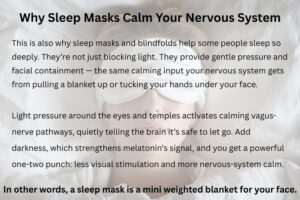
This isn’t psychology. It’s physiology.
Most people assume blankets are about warmth. That’s only partly true.
What your body actually responds to is light pressure and containment. Think swaddling. Even a thin sheet provides gentle sensory input that helps shift your nervous system out of “alert mode” and into “rest mode.”
That shift is governed by your parasympathetic nervous system — the part responsible for slowing your heart rate, lowering stress hormones, and allowing sleep to unfold naturally. Most people know the sympathetic system as “fight or flight.” The parasympathetic system is better described as “rest and digest.”
In other words, your blanket isn’t just a comfort habit.
It’s a regulatory cue.
It helps trigger parasympathetic tone.
But why?
3 Reasons You Want to Be Covered with a Blanket
- Pressure signals safety
Light pressure on your skin sends calming signals to the brain. This quiets the stress response and supports vagus-nerve signaling — the same pathway involved in relaxation, digestion, and sleep. That’s why weighted blankets help some people, and why others get the same benefit from a simple sheet. Read this article 5 Benefits of Using a Weighted Blanket.
You can read more about weighted blankets at the Sleep Foundation – CLICK HERE. - The brain sleeps better when it feels contained
Your nervous system is ancient. Long before memory or logic kicks in, the body asks one quiet question at night: Am I safe enough to completely let go?
Covering yourself creates a sense of enclosure that reduces nighttime vigilance — even if you’re not consciously anxious. From an evolutionary standpoint, sleeping uncovered meant exposure: predators, insects, cold, danger. Your modern brain knows you’re safe in bed. Your primitive brain isn’t fully convinced.
- Consistency matters more than coolness
Sleep research shows that stable skin temperature matters more than being cold. A light cover helps your body regulate heat evenly, which supports the natural drop in core temperature required for sleep.
How does this weird sleep issue even happen?! Why your nervous system wants a blanket but your foot wants freedom
Have you ever noticed that you sleep better covered up — yet still stick one foot out from under the blanket?
That’s not contradictory. It’s clever biology.
Being covered provides gentle pressure and containment, which calms the nervous system and signals safety. It activates parasympathetic tone and vagus-nerve signaling — the same pathways that help slow your heart rate, lower stress hormones, and allow sleep to unfold naturally.
In other words, the blanket stays because your nervous system wants comfort, grounding, and enclosure. But your feet are one of the body’s main heat-release zones. They’re loaded with special blood vessels that act like tiny radiators, letting excess heat escape. When your body is trying to fall asleep, it needs your core temperature to drop slightly.
Letting one foot stick out helps dump just enough heat to fine-tune that process without giving up the calming benefits of being covered. So what looks like a quirky habit is actually two smart systems running at the same time.
One part of your biology is saying, “I want pressure, containment, and safety.”
Another part is saying, “I need to cool down a little.”So your body compromises. The blanket stays. The foot escapes.
Your blanket is for your nervous system. The foot is for your thermostat.
It’s not a bad habit.
It’s elite sleep engineering.
Blanket Use Overlaps with Anxiety Sort Of — But Gently
I’m not talking about panic attacks or diagnosed anxiety disorders. I’m talking about the far more common experience of being:
- wired but tired
- mentally exhausted yet unable to settle
- easily startled awake
- restless in the middle of the night
In these cases, your body often reaches for self-soothing tools before the mind ever labels the feeling. Wanting to be covered with a blanket is one of them.
It’s your body saying, Help me downshift.

Do You tuck Your Hands Under Your Face? Does Your Cat?
It’s the same reason people instinctively tuck their hands under their chin or face when resting or drifting off to sleep. This position isn’t random, it’s neurological and deeply self-soothing. Gentle pressure around the face and jaw activates calming touch receptors and vagus-nerve pathways that tell the brain it’s safe to relax. It also eases tiny, unconscious tension in the jaw and throat that many of us carry without realizing it. I think of it as a mini weighted blanket for your face. Just like pulling a blanket up at night, this posture gives the nervous system containment, warmth, and grounding, all quiet cues that say, “You can let go now.” 
And here’s something that always makes me smile: Cats do this too.
When you see a cat resting with its paws tucked under its chest (the famous “cat loaf”), that’s not just a cute pose or a way to stay warm. It’s a self-soothing, nervous-system posture in the same way you do it when you pull up your blanket and tuck your hands underneath your face.
Tucking the paws inward creates gentle pressure and containment, protects vulnerable areas, and tells her brain it’s safe to relax. In other words, your cat is doing the feline version of pulling a blanket up or tucking your hands under your chin. Different species. Same biology. Same message to the nervous system: “I’m okay. I can rest now.”
What If You Don’t Have a Blanket?
When a familiar sleep cue is missing – whether it’s a blanket, pressure, or routine – the nervous system stays partially alert. It may explain why some people don’t sleep well in a hotel (at least that first night). But even at home it happens if you don’t have your blanket.
People will say they have:
- difficulty falling asleep
- more frequent awakenings in the early morning
- shallow or unrefreshing sleep
- a vague sense that “something feels off”
This is why blanket-hogging partners are more than a minor annoyance. It’s not about warmth. It’s about losing a calming signal your body expects. When two people need different conditions, something as simple as separate blankets can protect each person’s sleep — and canoodling together protects relationships.
What’s interesting is that this calming effect by a blanket doesn’t happen in isolation.
Melatonin (the hormone supplement most people think of as a “sleep aid”) doesn’t actually knock you out. Its real job is to signal safety and timing to the brain.
In that sense, pulling a blanket up at night and releasing melatonin are doing similar work: Both tell the nervous system that it’s okay to let go. Read THIS BLOG to learn when to take your melatonin because taking it when you crawl into bed is not good.

Two natural ways to support the same calming pathways
- Gentle pressure alternatives
If a blanket isn’t practical, hugging a pillow, placing a light, weighted blanket over your legs, or wearing snug sleepwear or leggings can offer similar sensory feedback. - Nutritional nervous system support
Magnesium is involved in calming nerve firing and supporting parasympathetic tone. This is one reason I offer Chelated Magnesium (glycinate) capsules. It’s easy on the tummy and doesn’t act like a sedative. For some people, it helps the body relax enough to let sleep happen. Even stronger, MagFocus® Powder, which offers MagTein® magnesium threonate – a type of magnesium that is useful for the nervous system.
I’ll add that herbs traditionally used for calming — like lemon balm or passionflower — can support the same pathways. My Sleep Script Tranquility Capsules were designed with this in mind, not to knock you out, but to help the nervous system stop resisting sleep.
A Quick Personal Note
I notice this most when I travel. If I forget to pull a blanket up — even in a warm hotel room — my sleep is lighter and more fragmented. Nothing dramatic. Just off.
That’s been true for years, and it’s one reason I pay attention when people tell me, “I don’t feel right unless I’m covered when sleeping.”
I believe them. Their body is giving useful feedback.
What About Babies and Toddlers? Do They Need a Blanket?
For safety reasons, babies under 12 months should never sleep with loose blankets because they don’t yet have the motor control or airway reflexes to move fabric away from their face. It presents a hazard. Instead, sleep sacks and wearable blankets provide warmth and gentle containment without the risk.
Somewhere between 18 and 24 months, most toddlers can safely use a light, breathable blanket – and interestingly, this is also when many of them suddenly want to be covered. That’s not a bad habit forming. It’s their nervous system discovering the same calming reflex adults still rely on: gentle pressure, warmth, and containment as a signal that it’s safe to let go and sleep.
This is the equivalent of hitting ‘Do Not Disturb’ on your nervous system because it provides gentle pressure, warmth, and containment. It’s telling the brain it’s safe to shut down for the night.
Summary
If you sleep better with a blanket — even when the ambient temperature in your bedroom is hot — that’s not a quirk or a weakness.
It’s a sign your nervous system knows how to ask for calm.
Sometimes the most effective sleep support isn’t another pill or protocol. It’s listening to the body’s quiet cues and responding with simple, natural tools.
If you’d like more ideas like this, you can download my free ebook “19 Ways to Sleep Better.” It’s packed with practical strategies you can use tonight — no prescriptions required.
Sleep doesn’t need to be forced.
Often, it just needs permission.




Suzy Cohen, RPh, has been a licensed pharmacist for over 30 years, blending conventional medicine with natural approaches to help people feel better and live healthier. She is the founder of Script Essentials, a supplement company known for targeted, custom-formulated products, some with patented innovations.
With a special focus on thyroid health, functional medicine, and drug-induced nutrient depletion (what she calls “drug muggers”), Suzy is the author of several books including Thyroid Healthy, Drug Muggers, and Diabetes Without Drugs. She also writes a nationally syndicated health column and shares practical, easy-to-understand guidance with readers around the world.