Six days ago, a little gray-blue kitten named Willow came home with us.
And I’m not exaggerating when I say she has jumped into my lap about 150 times since.
She buries her little head into the crook of my elbow, presses her face into any available nook or cranny, and just melts. She does the same thing to Sam. She has the most lovely purr which immediately starts upon lying down. She’s affectionate in a way that feels almost intentional, like she knows exactly what she’s doing. 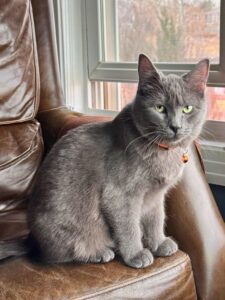
Here’s the part that surprised me.
As a young girl, I had pretty severe cat allergies from our cat “Sugar” which was an outdoor cat. Sneezing, itchy eyes, congestion – the whole snotty production. Sugar wasn’t that nice, she’d claw, hiss, bite and pounce at us. Yet here I am, days into kitten ownership, and I’m completely fine, not to mention smitten. No symptoms. Not even a sniffle. No itchy throat, all is well.
So what’s going on? How did I go from miserable allergies to zero reaction whatsoever. I’ll tell you in a minute.
It’s Not the Fur, It’s the Protein
Most people think they’re allergic to cat hair. They’re not.
The real issue is Fel d 1, a protein made primarily in a cat’s salivary and sebaceous (skin oil) glands. When cats groom themselves, the protein transfers to their fur, dries, becomes airborne, and settles on… everything! Some breeds of cats make more of this protein than others. Sugar made a lot of this. Russian Blue cats (which I think is what Willow is in part) produce much less Fel d 1 than other cat breeds.
Here’s what’s fascinating:
- Fel d 1 is not unique to house cats
- Big cats (like tigers, lions, and panthers) also produce Fel d 1
- Yes, technically, if you cuddled a tiger long enough, you could react (though allergies would not be your biggest concern in that scenario)
The difference isn’t whether the protein exists – it’s how much is produced and how easily it becomes airborne.
Some cats naturally make less.
That includes:
- Kittens
- Female cats
- Neutered cats
- Certain genetic lines
- And very importantly… specific individual cats
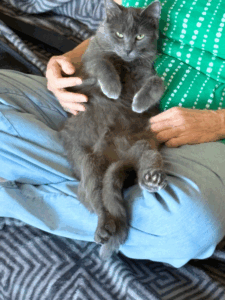
Willow barely sheds, and there’s never a single hair on my clothes or furniture. Less fur means less dried saliva—and less of the Fel d 1 protein—floating around the house. But shedding alone probably isn’t the whole story. I suspect she simply produces less Fel d 1 to begin with. And honestly, I’m different now too. At 61, I’m healthier than I was at 35.
My gut is calmer, my immune system feels steadier, and years of focusing on nutrition, natural remedies, and stress reduction have lowered my overall inflammation. When your body isn’t on high alert all the time, it tends to overreact less. Maybe Willow changed… or maybe I did. Probably a little of both.
Let’s Just Call it Cat Therapy
What struck me even more than the lack of allergies was how calm I suddenly felt. I don’t live in fight-or-flight mode, but like most women juggling family, health, and life, my mind is usually busy. Within ten minutes, the mental chatter quieted. The to-do list faded. My body softened. That’s not sentiment, it’s physiology. And purring- lots of purring.
Close contact with a calm, affectionate cat or dog, or any “therapy” pet has genuine biological impacts on you. Here’s what can happen:
- Increase oxytocin (the bonding, calming hormone)
- Lower stress hormones like cortisol
- Reduce excess catecholamines like adrenaline and norepinephrine
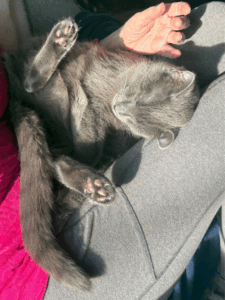 Some cats are aloof. Some are little thugs — I laugh way too hard at those chaotic cat videos on YouTube. Some are fiercely independent and act like they’re renting space in your house. And then there are cats like Willow — full-on Velcro types who seem biologically gifted at calming a human nervous system.
She only had days left to be adopted. Rescuing her was supposed to be the blessing for her — but honestly, it feels like the blessing was mine.
Why Stress Chemistry Matters for Allergies
The immune system doesn’t work in isolation.
High catecholamines can amplify inflammatory responses, including allergic ones.
A calmer nervous system is more tolerant of allergens.
That doesn’t mean anyone should “push through” real allergies, that’s super uncomfortable and I don’t recommend it. But it helps explain why one cat can trigger misery, while another is a non-issue to the same person.
Sometimes it’s not about forcing adaptation. It’s about finding the right match for you. If you have allergies and can’t put your finger on why, you might find a clinical pearl here: The Best Honey for Allergies: Raw Unfiltered vs. Pasteurized Comparison
There’s also something fascinating happening neurologically. Baby animals — kittens especially — activate what scientists call the “baby schema” response in our brains. Those big eyes, round faces, and tiny bodies light up the same caregiving and empathy centers that respond to human infants. Oxytocin rises, stress hormones drop, and you naturally feel protective and calm. In other words, kittens aren’t just cute — they’re biologically designed to soften your nervous system. No wonder I can’t stop holding my little fuzznugget.

Are Asthmatics at Higher Risk?
Yes, they are. And this part matters, so read on if you have asthma, allergies, or frequent lung problems related to something else.
People with lung problems, especially allergic asthma, can be more sensitive to airborne allergens like Fel d 1. Reactions may show up not as sneezing, but more like:
- Chest tightness
- Cough
- Wheezing
That doesn’t automatically mean cats are off-limits, but it does mean extra caution, pre-exposure visits, good air filtration, and guidance from a healthcare provider are wise. It might also mean a low Fel d 1-producing cat is your best choice.
I’m not a vet, however my research reveals that some of the lowest Fel d 1-producing breeds are Russian Blues (like Willow who is a DSH/RB mix), Balinese (which are long-haired Siamese), Devon Rex, and surprisingly, those long-haired Siberians.
Gentle, Non-Drug Supports (When Needed)
I don’t love telling people to take daily antihistamines forever. The anticholinergic side effects are challenging, things like blurry vision, constipation, and dizziness. Sometimes they’re necessary, but they’re not the only option.
Some people find relief from:
- Quercetin or DHQ (from foods or supplements)
- Vitamin C (food-based is best) – try my 100% natural Vitamin C with DHQ
- Butterbur (PA-free extracts only)
- Stinging nettle (mild, not magic)
And boring in a good way, but still effective:
- Saline nasal rinses
- HEPA air purifiers
- Washing hands after petting
These don’t “cure” allergies—but they can take the edge off and sometimes that’s all you need to have a good day.

If You’re Allergic but Dream of a Cat, Consider This:
Here’s the short list I wish more people knew:
- Spend time with that exact cat before adopting
- Kittens often trigger fewer reactions than adult cats
- Individual biology matters more than breed labels
- Softly brushing your cat and using hypoallergenic unscented cat wipes on occasion helps
- Air filtration beats daily pills for many people
- Early-life exposure (especially in toddlers) may reduce allergy risk later
And no, you don’t automatically need Claritin for life.
Sometimes, you just need the right cat.

Willow, the Unexpected Healer
I don’t know if Willow is part Russian Blue, part domestic shorthair, or something else entirely.
What I do know is this:
She didn’t trigger my allergies.
She triggered oxytocin – I’m in loooooove!
She quieted my catecholamines as many pets can do.
And she reminded me how powerful simple connection can be.
She got me to put all my devices down for hours, lol.
Not every cat is like this.
But every once in a while, one shows up who knows exactly what you need—
And squeezes her head up right into your elbow to deliver it.
Yes – Allergies Can Fade, Change, or Disappear
In case you’re wondering I’m living proof. I had severe cat allergies for decades. I grew up with a cat (and dog) until the age of about 20. Allergies are very immune responses, not permanent labels. Your immune system is dynamic. It learns, adapts, and sometimes… stands down.
People can and do:
- Outgrow allergies
- Lose sensitivity over time
- React to one animal but not another
- React during one life phase and not another
Why You Might Not Be Allergic Anymore
- Immune tolerance can develop
Repeated low-level exposure (especially earlier in life) can teach the immune system that a substance is not a threat. This is the same principle behind allergy shots, just slower and more natural. - Hormones change immune behavior
Puberty, pregnancy, menopause, and aging all shift immune signaling. What triggered reactions at age 8 may be irrelevant at 50. - Lower inflammatory load overall
When the body is less inflamed (better gut health, lower stress, fewer triggers), allergic reactions often quiet down. - Different exposure ≠ same allergen
Not all cats produce the same amount of Fel d 1. You may not be “less allergic”—you may simply be exposed to far less allergen. - Nervous system tone matters
High stress chemistry (catecholamines) can amplify immune reactions. A calmer nervous system can mean fewer symptoms.
This is one reason people say:
“I’m allergic to most cats—but not this one.”
They’re not imagining it.
What This Does Not Mean
- It doesn’t mean allergies were “fake”
- It doesn’t mean you should force exposure
- It doesn’t mean allergies can’t return under stress or illness
It simply means the immune system is flexible, not fixed.

A Practical, Grounded Take
If someone says:
“I used to be allergic, but now I’m not”
That’s not unusual. That’s biology doing what biology does… adapting.
And sometimes, the proof isn’t a lab test.
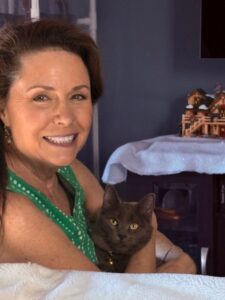
It’s six hours in, a kitten in your lap, and no symptoms at all.
That counts.
But Aren’t Allergies Permanent?
No, allergies aren’t permanent labels, they’re immune responses at a certain time. And your immune system is remarkably adaptable. It can learn tolerance, stand down over time, and even stop reacting altogether which is what happened to me.
Hormonal shifts, reduced overall inflammation, changes in stress chemistry, and different levels of allergen exposure all influence whether symptoms appear. This is why someone can be very allergic in childhood, mildly reactive in adulthood, or seemingly not allergic at all years later. It doesn’t mean the allergy was imagined—it means the immune system recalibrated. That kind of change is not rare; it’s biology doing what it’s designed to do.
How Do You Spend Time with a Cat Prior to Adoption
I say “spend time with that exact cat,” I don’t mean you need a perfect, laboratory-clean test environment, trust me I tried that and couldn’t find such a place at rescue shelters, cat cafes and pet shops. That just doesn’t exist. Breeders’ homes, shelters, cat cafes and pet stores always have multiple cats, shared air, and higher background allergen levels. Ironically, if you don’t react in those settings, that’s actually a good sign, not a confounder.
Here’s how to make that advice practical rather than theoretical. You’re not trying to prove zero exposure. You’re looking for:
- Immediate red flags (itchy eyes, wheezing, hives)
- Delayed reactions over the next few hours
- Whether symptoms escalate or settle
If you can sit, hold, and interact with a kitten in a multi-cat environment and walk away feeling fine, your odds at home, where allergen load is much lower, are way better.
A Smarter, Real-World Approach
I really think you should visit the cat you’re interested in more than once, even if it’s just for 15 minutes the second time around. Hold the cat or kitten, then touch your face later (that’s a real test). Also, make sure to avoid antihistamines that day so your reactions aren’t totally masked.
One other thing, most people think of sneezing and itchy throats as reaction but I’d say pay attention to chest symptoms too. For example, pain or tightness in the chest, difficulty breathing or coughing.
If you buy from a breeder, many of them will allow you to have a short trial period, and possibly a one or two week return policy if allergies flare. They might even hve a single room where you can enjoy a quiet visit with your proposed fur baby (without multiple cats/kittens in the space). Not perfect, but definitely workable.
If you have no reaction in a busy, multi-cat space like a shelter or pet store, that’s often more reassuring than testing in a pristine home. The allergen concentration is higher there. If your immune system stays calm under those conditions, it’s likely to do even better once the cat is the only one in your home.
As an Aside – Her Name has Medicinal Meaning
The name “Willow” comes from the willow tree which has a beautiful history in folklore and herbal medicine. Willow branches don’t snap in a storm — they bend and sway. That isn’t fragility, it’s resilience. Quiet strength. The ability to move with life instead of fighting it. Something we could all do better at.
For a little rescue kitten who has already learned how to adjust and trust again, it felt perfectly symbolic. And here’s the pharmacist trivia I love: willow bark contains salicin, the natural compound that inspired the blockbuster aspirin! How sweet is that — a tiny creature who lowers my stress named after something known for healing benefits? Across cultures, willow represents intuition, nurturing, protection, grace, and that soft-but-powerful energy I adore.




Suzy Cohen, has been a licensed pharmacist for over 30 years and believes the best approach to chronic illness is a combination of natural medicine and conventional. She founded her own dietary supplement company specializing in custom-formulas, some of which have patents. With a special focus on functional medicine, thyroid health and drug nutrient depletion, Suzy is the author of several related books including Thyroid Healthy, Drug Muggers, Diabetes Without Drugs, and a nationally syndicated column.