I’ve made this sourdough bread recipe at least 20 times now, and it turns out beautifully every single time. It’s truly foolproof — and it makes the whole house smell absolutely incredible while it bakes. The featured image is my actual loaf, even though it honestly looks like something I bought off Shutterstock.
If sourdough has ever intimidated you, please don’t let that stop you. This recipe is forgiving, flexible, and very hard to mess up. You don’t need fancy tools or perfect timing. You just need a little patience and one important thing: an active starter.
Make sure your sourdough starter is nice and bubbly and happy before you begin. That’s the big deal. I always feed mine several hours in advance (or the night before) so it’s at peak activity when I mix the dough. When your starter is strong, everything else falls into place.
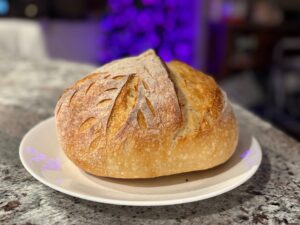
This has become my go-to loaf because it works — crisp crust, tender crumb, and true bakery-quality flavor.
You’ve got this. 😊
Ingredients for Sourdough Bread
100 gm live, bubbly sourdough starter
10 gm salt
305 gm spring water (do not use alkaline water, use normal tap or spring water)
450 gm bread flour
Directions
1. Mix and rest
In a large bowl, use a dough whisk or spatula and mix the active sourdough starter, water, salt, and flour until a shaggy dough forms. Use a digital weigh scale to accurately measure your ingredients. Don’t knead it, just mix it well. Cover the bowl with a clean towel and let the dough rest for 30 minutes. This short rest helps the flour absorb water and makes the dough easier to work with.
2. Stretch and folds
After the 30 min. rest, begin your stretch and folds. With slightly damp hands, lift one side of the dough and fold it over itself, then rotate the bowl and stretch and fold again, folding four times – imagine it as north, south, east, and west. This is one full set of stretch and folds.
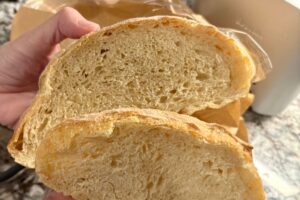
Repeat this process every 30 minutes for a total of 3 stretch and fold sessions. The dough should feel smoother and more elastic after each round.
3. First bulk fermentation
Transfer the dough to a lightly oiled bowl. Place it seam-side up, cover with a towel again, and let it rest (ferment) at room temperature for approximately 4 to 5 hours. This allows the dough to rise and it will be somewhere between 30–50% larger than when you started. The speed at which this rise occurs depends on your kitchen temperature. Bigger is not better here – you don’t need to shoot for “double in size” like many youtubers suggest. Over-fermenting makes shaping harder later.
4. Pre-shape and final shape
After the first bulk fermentation (when your dough has increased in size by about 30–50%), gently turn it out onto a lightly floured surface. Using floured hands, do about 8–10 gentle push-and-pull motions to bring the dough into a loose round. If you’ve never done this before, don’t overthink it — you’re simply nudging the dough inward from the edges to create a soft ball and a bit of surface tension. (If it helps, imagine you’re shaping it into a candy cane and then curling it back onto itself.)
Once it’s loosely rounded, do one single round of letter folds to organize the gluten: gently stretch the dough into a rough rectangle, fold it into thirds like a letter (top down, then bottom up), and turn it seam-side down.
That’s it — no need to overwork it here. You’re just giving the dough a little structure before the next rest.
Flip the dough seam-side down and gently tighten it into a round. Don’t overwork it. Now it’s time for cold fermentation.
5. Cold fermentation
Dust your banneton generously with flour. (I prefer rice flour for this step because it doesn’t absorb moisture and prevents sticking, but any flour will work.)
Place the dough into the banneton seam-side up. Cover with a towel or a clean shower cap, then refrigerate for 8–12 hours.
This slow, cold fermentation deepens flavor, improves structure, and makes the dough much easier to score and bake the next day.
6. Preheat and Score
Preheat your Dutch oven to 475°F for at least 30 minutes, preferably an hour.
Optional step (not required, but helpful):
Sometimes I move the dough from the refrigerator to the freezer for about 10–15 minutes right before baking. This firms up the surface slightly, which makes scoring easier and can help the loaf hold its shape and rise a bit better in the hot oven. Totally optional — your bread will still turn out beautifully if you skip the freeze.
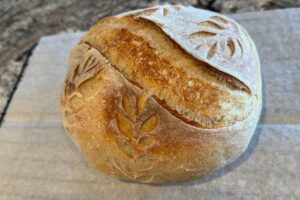
When you’re ready to bake, carefully turn the chilled dough out onto a piece of parchment paper. Using a sharp knife or bread lame, score the top of the loaf with one confident slash (or your favorite pattern).
This helps control how the bread expands in the oven and gives you that beautiful artisan look.

7. Bake
Carefully place the sourdough loaf into the hot oven, cover, and bake at 475°F for 30 minutes. If you have a Dutch oven or bread oven, use it. It creates steam and helps develop a beautifully crisp, golden crust. Then after the 30 minutes, remove the lid, reduce the temperature to 425°F, and continue baking uncovered for 8–10 minutes, until the crust is deeply golden and crisp. Let the bread cool fully before slicing. You want it closer to 90–100°F inside before cutting into it. Cutting prematurely releases trapped steam and can leave the crumb gummy, even if the loaf is fully baked.
Note: Some people add water or an ice bath to the oven to create steam inside the oven, but I don’t do that. I actually prefer a crispier crust — and a Dutch oven or bread oven traps its own steam anyway. In my experience, you don’t need to add extra water for great results.




Suzy Cohen, RPh, has been a licensed pharmacist for over 30 years, blending conventional medicine with natural approaches to help people feel better and live healthier. She is the founder of Script Essentials, a supplement company known for targeted, custom-formulated products, some with patented innovations.
With a special focus on thyroid health, functional medicine, and drug-induced nutrient depletion (what she calls “drug muggers”), Suzy is the author of several books including Thyroid Healthy, Drug Muggers, and Diabetes Without Drugs. She also writes a nationally syndicated health column and shares practical, easy-to-understand guidance with readers around the world.