Let me say something that might ruffle a few feathers. Glucosamine has one of the best marketing departments in the supplement industry – and one of the most disappointing report cards in clinical research.
That’s not exactly the kind of thing you’ll read on the side of the bottle.
Yet here we are.
For nearly 30 years, I’ve been raining on glucosamine’s parade. Believe me, it hasn’t made me popular with companies that sell it. But my loyalty has never been to an ingredient. My loyalty has always been to you, and evidence.
And after reading the research that spans decades, I still have the same question I had back in the 90’s:
Where’s the proof?
Not the testimonials.
Not your neighbor’s aching knee.
Not the celebrity endorsement.
The proof. Because here’s something I’ve learned after 30+ years as a pharmacist:
Supplements never get grandfathered into effectiveness.
I don’t care whether an ingredient has been on store shelves for five years or fifty. Every ingredient has to keep earning its place. That’s exactly what you expect from medications, and it’s what you should expect from supplements too.
Glucosamine earned a lot of popularity. I’m just not convinced it earned all the praise.
It Sounds Like Common Sense. That’s the Problem.
If you’ve ever bought glucosamine, don’t feel embarrassed. The marketing is brilliant because it tells a story that sounds perfectly logical:
Your cartilage contains glucosamine.
Your knees hurt.
Take more glucosamine to rebuild your cartilage.
Simple, right? Except… the human body is a lot more complicated than “eat X to rebuild X.”
If that were true, eating brains would make us smarter, eating liver would cure liver disease, and orthopedic surgeons would be handing out glucosamine instead of knee replacements.
This one is personal for me. My husband, Sam, underwent a partial knee replacement years after an old football injury from his quarterback days. Recovery wasn’t easy, and despite hoping it would solve the problem, he’s still disappointed with the surgical outcome. Believe me, if there had been a supplement that truly rebuilt cartilage the way the hype suggests, we would have been first in line.
The glucosamine story is beautiful. Unfortunately, the evidence isn’t.
Gucosamine Is the Avocado Toast of the Joint Supplement Aisle
Everybody buys it because everybody else buys it.
It’s been around a long time. Your mom probably took it. Your golfing buddy swears by it. Your local pharmacist probably recommended it. Even a handful of orthopedic doctors have shrugged and said, “Well…it certainly can’t hurt.”
That statement has probably sold more bottles than any television commercial ever made.
But popularity isn’t proof. Shelf space isn’t evidence. If it were, the breakfast cereal aisle would be a cardiologist’s dream.
Here’s something worth remembering: Popularity is not a biomarker of how well something works. Neither is longevity.
The Question I’ve Been Asking for Decades
Whenever I hear an ad that glucosamine “works,” my first question is always the same.
Compared to what?
Compared to doing nothing? Compared to physical therapy? Compared to losing twenty pounds? Compared to taking an anti-inflammatory med like ibuprofen or celecoxib?
Or… maybe compared to a placebo?
Because when you actually compare glucosamine against a sugar pill in the highest-quality clinical trials, the results become a lot less impressive than the advertisements. Read how well placebos work in my article HERE.
We’ve had almost 30 years to answer this one simple question. How much more research do we need before we’re willing to admit that glucosamine (and it’s sidekick chondroitin) simply hasn’t lived up to the hype?

So Then the NIH Spent Millions to Settle the Argument
In 2006, the National Institutes of Health decided to answer the glucosamine question once and for all.
Not with another tiny study. Not with another manufacturer-funded trial. (We have hundreds of those).
With one of the largest and most rigorous osteoarthritis studies ever conducted. It’s called the GAIT trial which stands for the Glucosamine/Chondroitin Arthritis Intervention Trial.
This wasn’t a casual little experiment. It enrolled 1,583 patients at 16 medical centers across the United States. It was randomized, double-blind, placebo-controleld study (like a real one!)
And published in the New England Journal of Medicine.
It was funded with more than $12 million in our taxpayer dollars. If glucosamine truly rebuilt cartilage and relieved joint pain the way decades of marketing suggested, this was its chance to prove it.
It didn’t. 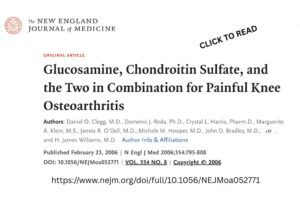
In the overall group of patients with knee osteoarthritis, glucosamine did not perform significantly better than placebo.
Neither did chondroitin.
Neither did the combination of the two.
Read that again.
The biggest study ever conducted on these ingredients found they didn’t outperform a sugar pill for most people.
The most intriguing part for me was that the placebo worked surprisingly well. About 60% of people taking the placebo reported meaningful improvement in their knee pain. Pretty remarkable. But it tells us something crucial about arthritis pain that marketers would rather not discuss. We’ll get to that in a minute. First, though, let’s answer the question I hear all the time…
“If glucosamine doesn’t really work, why do so many people swear by it?”
Why Did the Early Studies Look So Good?
If glucosamine has disappointed in larger clinical trials, here’s a fair question: Why did it ever become famous in the first place?
Because the earliest studies looked encouraging. Many were relatively small, and only lasting a few months. Several, maybe most, were funded by companies that manufacture glucosamine or have some relation to sourcing it.Does industry funding automatically invalidate a study? Maybe so, maybe not – I’ll let you decide that.
But this part is true. Decades of medical research have shown that industry-sponsored studies are more likely to report favorable results than independently funded research. That’s true for drugs, supplements, and medical devices. It doesn’t necessarily mean anyone cheated or skewed results. It just means we should consider the quality of the evidence before drawing conclusions about efficacy.
Then along came the NIH.
Unlike a company or spokesperson trying to sell a product, the National Institutes of Health had no financial reason to prove glucosamine worked, or didn’t.
They simply wanted a straight answer. And when the dust settled after the GAIT Trial, the answer wasn’t nearly as exciting as the advertisements.
To me, that’s exactly how science is supposed to work. You start with a hypothesis and then test it. Then evaluate the evidence, and draw a conclusion.
“But My Knees Feel Better!”
I believe you. Seriously. I’m not rolling my eyes.
I’m not calling you a liar. Pain is personal, and if you say your knees feel better on glucosamine, then I believe your knees feel better.
But here’s where things get interesting. In the GAIT Trial, about 60% of people taking a placebo also reported significant pain relief.
Think about that for a minute. Doing nothing (but taking a fake sugar pill) caused people to say their “knees felt better.” Let me repeat that please…
Six out of every ten people improved after taking absolutely nothing medicinal.
That’s not because they were foolish. It’s because pain is wonderfully complicated. Remember, arthritis pain naturally comes and goes, or at least is better on some days and worse on others.
Maybe you started glucosamine right after a miserable flare-up. It’s completely fair to say your symptoms were going to improve anyway.
Maybe you also started walking more. Maybe you lost a few pounds. Maybe you began sleeping better. Maybe hope played a role. Hope is surprisingly powerful medicine. I should write about that one day.
None of that means your improvement wasn’t real. It simply means glucosamine may not deserve 100% of the credit. As pharmacists, we’re trained to ask one annoying question over and over again: Compared to what?
That’s why placebo-controlled trials matter. Without them, everyone would still believe dozens of ineffective treatments worked.
Here’s an example that always makes me smile. In 2003, researchers actually STUDIED leeches (!) for knee osteoarthritis and compared them with topical diclofenac (Voltaren). Believe it or not, the leech group reported greater pain relief during the first several weeks!
But there are obvious questions: How much of that improvement came from chemicals in the leech’s saliva…and how much came from having leeches sucking on your knee?
So they went back to the drawing board. In a later study, they even created artificial leeches as a placebo. Everyone improved, including the placebo group. Even the researchers couldn’t confidently determine how much of the benefit came from the leeches themselves versus the powerful effects of expectation and placebo.
If scientists are willing to make fake leeches to separate fact from fiction, I think it’s reasonable to expect glucosamine to outperform a sugar pill before we crown it the king of joint supplements.
Here’s the Part the Commercials Usually Skip
Now let’s talk about something that fascinated me from the beginning. Even if glucosamine actually could stimulate cartilage cells, how does it get in there?
That’s not a trick question. It’s basic pharmacology.
When you swallow a capsule, the ingredient doesn’t magically teleport to your sore knee. It has quite a journey.
First, it travels down your esophagus into your stomach, where it’s exposed to stomach acid and digestive enzymes. Next comes absorption, meaning it has to cross the wall of your small intestine and enter your bloodstream. That’s hurdle number one.
Then comes first-pass metabolism. Before much of what you’ve absorbed ever reaches the rest of your body, it passes through the liver, which acts like your body’s chemical processing plant. Some compounds are altered there, some are broken down, and some are sent on their way.
Next comes distribution. Once in your circulation, the ingredient isn’t headed exclusively to your knee. It’s distributed throughout your entire body, reaching countless tissues and organs.
Finally, and this is the part glucosamine advertisements rarely mention, it has to reach your cartilage in meaningful concentrations. That’s easier said than done because cartilage has no direct blood supply. Nutrients reach it primarily by slowly diffusing through the synovial fluid that bathes the joint.
That’s a long trip with a lot of opportunities to fall short. Then whatever survives has to circulate throughout your whole body. Only after all of that does it have a chance of reaching your joints where it can build cartilage.
That’s a lot of hurdles!
And here’s what researchers found. After a standard oral dose of glucosamine, blood levels rise, but only to very low concentrations. Researchers have pointed out that these levels are far below the concentrations commonly used in laboratory studies where glucosamine appeared to stimulate cartilage cells. That’s a pretty important fact.
Imagine a gardener showing you spectacular results after using half a cup of fertilizer on every plant. Then imagine trying to duplicate those results at home with just a teaspoon. Would you expect the same outcome? Probably not. That’s one of the challenges with glucosamine research.
If the concentrations used in the lab can’t realistically be achieved in the human body after swallowing a capsule, we have to ask whether those findings translate into real life.
I’m not being cynical, just scientifically honest with you. And speaking of that, I should give you a safety note next.
⚠️ Pharmacist’s Note
Most glucosamine supplements are made from the shells of shrimp, crab, or lobster (although vegan versions made by fermentation are available).
If you have a shellfish allergy, talk with your healthcare provider or allergist before taking glucosamine. While the allergenic proteins are largely removed during manufacturing, trace contamination is still possible, and reactions have been reported.
Also, if you take warfarin (Coumadin®), don’t start glucosamine without medical supervision. It has been associated with increased INR and a higher risk of bleeding in some people.
Your Knee Isn’t a Sponge
Here’s another little fact that’s rarely mentioned in advertisements.
Cartilage does NOT have its own blood supply. Unlike your liver, kidneys, muscles, or skin, healthy cartilage isn’t directly nourished by blood vessels. Instead, nutrients slowly diffuse through the synovial fluid that bathes the joint.
Despite all the marketing claims about “feeding cartilage,” no one has convincingly demonstrated that the tiny amounts reaching the joint after oral supplementation are enough to rebuild worn cartilage in people with osteoarthritis. About the only thing glucosamine consistently seems to produce in some people is gas. 
Biology Isn’t IKEA Furniture
This may be my biggest philosophical disagreement with glucosamine marketing. It treats the human body like it’s assembling a bookshelf. Need more cartilage?
Just swallow cartilage-building ingredients.
Done.
I wish biology were that simple but it isn’t. Your body is constantly making, breaking down, repairing, recycling, and remodeling tissues using extraordinarily complex biochemical pathways. Your cartilage cells already manufacture glucosamine from glucose inside the body.
That doesn’t automatically mean swallowing more glucosamine is useless. But it certainly raises an important question: Does taking more from a bottle actually change what happens inside those cells?
Your cartilage cells already have the machinery to manufacture glucosamine from glucose.
That doesn’t prove supplementation can’t help. Many substances made naturally in the body can also be useful as supplements under the right circumstances (ie creatine, CoQ10, catalase, melatonin, glutathione). The real question is whether swallowing glucosamine changes what happens inside cartilage enough to improve pain or preserve the joint.
After decades of research, the evidence is far less convincing than the marketing.
And that’s why I’ve never been impressed by the simplistic message that you can “feed your joints” by swallowing glucosamine.
It makes for terrific advertising. It just doesn’t make for terrific science.
So What Should You Take?
At this point, you might be thinking:
“Okay, Suzy. If not glucosamine, then what?”
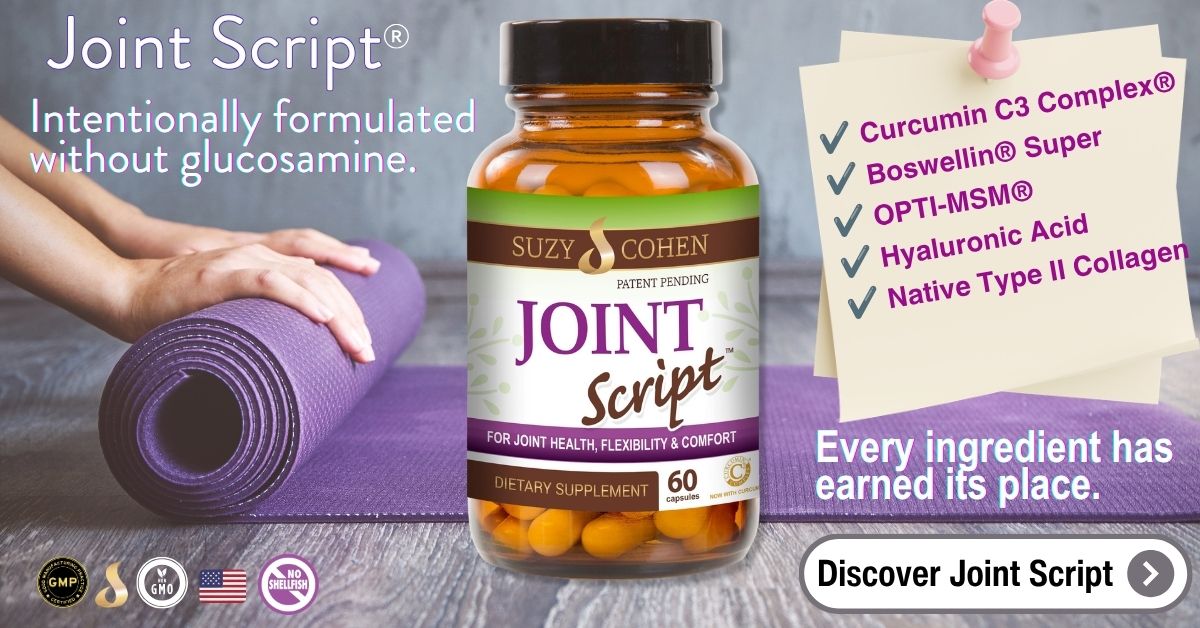
Fair. When I formulated Joint Script, I didn’t start with the ingredients that had been sitting on pharmacy shelves for the last 30 years. I didn’t start with the most profitable ingredients either. That’s not how I roll.
I started with a different question.
If I were building a joint formula from scratch today, knowing everything we know now, what would I put in the bottle?
(Notice what I didn’t do. I didn’t throw glucosamine and chondroitin into the formula simply because everyone else does and I wanted to compete).

I started with the evidence instead of tradition. Every ingredient had to earn its place.
Curcumin C3 Complex® made my cut because it has impressive research supporting its role in healthy inflammatory pathways.
Boswellin® Super earned its place because boswellia has consistently demonstrated benefits for joint comfort in clinical studies.
OPTI-MSM® contributes sulfur, an important building block for connective tissues, and has its own growing body of evidence.
KOLLAGEN II®-xs provides collagen peptides, structural proteins naturally found in cartilage.
Sodium hyaluronate helps support the slippery, well-lubricated environment that healthy joints depend on.
Ginger has centuries of traditional use and modern research supporting its role in joint comfort.
Notice something? This formula doesn’t bet everything on a single ingredient. It supports joints, tendons, ligaments and flexibility from all kinds of angles. That’s exactly what you want to feel better fast.
My Bottom Line 
I’ve been the odd pharmacist out on glucosamine for nearly 30 years.
While it became one of the biggest-selling joint supplements in America, I kept asking questions because, frankly, it has always been a head-scratcher to me.
Where’s the solid, reproducible evidence?
How much actually reaches the joint?
Does it outperform placebo?
Can those results be repeated?
I’ve never believed popularity should outweigh good science. It didn’t 30 years ago, and it doesn’t today.
My job has never been to recommend what’s fashionable.
My job has always been to recommend what has the best evidence behind it.
Sometimes those are the same thing.
Sometimes they’re not.
If you’ve been taking glucosamine and you feel it’s helping, I’m not here to argue with your experience or tell you to stop. But if you’re still living with stiff, aching joints after faithfully taking it for months, maybe it’s time to ask whether it’s the right tool for the job.
That’s exactly how I formulated Joint Script®. I didn’t build it around the best-known, or easiest-to-source raw materials. I built it around the ingredients I believe have earned their place through better science.
Because shelf space isn’t evidence. Marketing isn’t evidence. Popularity isn’t evidence.
Your outcome and results matter more.
Related Articles
Collagen Peptides: The 4 Main Ingredients Needed for Joint Comfort
7 Natural Alternatives to Drugs to Relieve Joint Pain Fast
Boswellia Reduces Pain and GI symptoms
Which is Better, Advil or Tylenol?
5 Natural Strategies for Rheumatoid Arthritis Pain

Suzy Cohen, RPh, has been a licensed pharmacist for over 30 years, blending conventional medicine with natural approaches to help people feel better and live healthier. She is the founder of Script Essentials, a supplement company known for targeted, custom-formulated products, some with patented innovations.
With a special focus on thyroid health, functional medicine, and drug-induced nutrient depletion (what she calls “drug muggers”), Suzy is the author of several books including Thyroid Healthy, Drug Muggers, and Diabetes Without Drugs. She also writes a nationally syndicated health column and shares practical, easy-to-understand guidance with readers around the world.