Have you ever awakened with numb hands at night so much so, you have to shake it back to life? Maybe your fingers tingle, burn, or feel like little electrical currents are running through them. You shake your hand a few times, the feeling returns, and you go back to sleep. Until tomorrow night, when it happens again! It’s happened to me on occasion, and it got me wondering what the reasons are for hands going numb like this.
Most people assume they’ve slept on their arm funny. And sometimes that’s exactly what happened. But recurring hand numbness can have other explanations, including a pinched nerve, blood sugar problems, thyroid dysfunction, or even a vitamin imbalance.
As a pharmacist, I’m particularly interested in the nutritional and medication-related causes because they’re almost always overlooked while you’re sent in for all kinds of tests and scans. I’ve spent years writing about how medications can deplete certain nutrients, a concept I call Drug Muggers. And as you’ll see, the B vitamins, particularly B12 is especially important when we’re talking about nerve health.
Before we get into the causes, here’s a little trick. Pay attention to WHICH fingers are numb. Your thumb, index, and middle fingers tell a different story than your pinky and ring finger. And if your feet are tingling too, that’s another clue altogether.
Let’s look at the seven most likely possibilities:
1. Carpal Tunnel Syndrome
This is probably the first thing your doctor will consider, especially if the numbness wakes you from sleep.
Carpal tunnel syndrome occurs when the median nerve becomes compressed as it passes through a narrow opening in your wrist. The nerve supplies sensation to your thumb, index finger, middle finger, and part of your ring finger.
The pinky is usually spared. That’s an important distinction.
Women develop carpal tunnel syndrome more frequently than men, and symptoms often become worse at night. Why? Because many of us sleep with our wrists curled underneath our pillows or bent toward our bodies. This increases pressure on an already irritated nerve.
You might also notice yourself shaking your hands to restore sensation. Some people experience burning or pain, while others simply complain that their hands (or fingers) keep falling asleep.
One of the simplest things to try is a wrist splint worn at bedtime. You want one that holds your wrist in a neutral position, not so it’s bent forward or backward. These are available at most pharmacies or on Amazon, and they don’t have to be expensive to work well.
If you’re dropping things, losing grip strength, or noticing weakness around your thumb, please get evaluated sooner rather than later. Nerves (like cats!) don’t appreciate being squeezed too tightly or for too long.
2. Cubital Tunnel Syndrome
Here’s one that people don’t always think about. Your elbow!
The ulnar nerve travels along the inside of your elbow, right around the area we call the funny bone. Of course, there’s nothing funny about banging it on the corner of your desk! When this nerve becomes irritated or compressed, you may develop tingling or numbness in your pinky and the adjacent half of your ring finger.
If those are the two fingers giving you trouble, I’d be looking at your elbow rather than your wrist.
Sleeping with your elbows tightly bent is a common aggravating factor. Think about how you curl up at night with your hands tucked near your face. You may be keeping that nerve stretched or compressed for hours.
Repetitive elbow bending or prolonged pressure on the elbow can aggravate things too. Even certain yoga poses, such as repeated chaturangas, may irritate an already sensitive nerve. And don’t confuse this with golfer’s elbow, which involves the tendons on the inside of your elbow and typically causes pain rather than finger numbness.
Try sleeping with your elbows a little straighter. Some people benefit from a soft elbow brace or even a loosely wrapped towel that discourages excessive bending. And if you spend hours leaning on your elbows while working at a desk, that’s worth changing too. You can read more about cubital tunnel syndrome at the John Hopkins SITE. 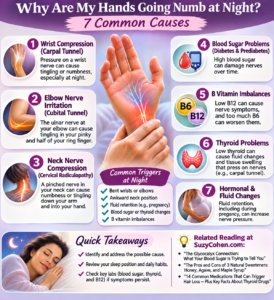
3. A Pinched Nerve in Your Neck
Sometimes your hand is perfectly innocent and the trouble is coming from your neck!
The nerves that supply your arms and hands originate in the cervical spine. If one of those nerve roots becomes irritated or compressed, you can experience numbness, tingling, pain, or weakness farther down the arm. Doctors call this cervical radiculopathy.
Arthritis, degenerative disc changes, and herniated discs are among the possible causes. Sometimes symptoms travel from the neck into the shoulder and down the arm. Other times, the hand symptoms are more noticeable than the neck discomfort.
Here’s a clue: Does turning your head or tilting your neck change the tingling in your arm? If so, the problem may be higher up than you think.
Pillow height matters too. If you’re sleeping with your neck sharply bent all night, perhaps because you’ve elevated the head of your adjustable bed too high, you’re not doing those irritated nerves any favors. Try adjusting your pillow or bed angle so your neck stays in a comfortable, neutral position.
Physical therapy can be helpful, particularly exercises designed to improve posture, mobility, and muscle strength. Gentle massage or a TENS unit (which delivers mild electrical impulses through the skin) may provide temporary pain relief for some people, although evidence for TENS is limited. Neither treatment necessarily fixes the underlying nerve compression. And while supplements may support general nerve health, they generally won’t correct a mechanically pinched nerve. That’s an important distinction!
Persistent numbness or weakness warrants a proper examination, especially if you’re noticing a loss of strength.
4. Blood Sugar Problems
Most people know that diabetes can damage nerves, but they don’t always realize that nerve symptoms may develop gradually, sometimes before diabetes has been formally diagnosed. Diabetic peripheral neuropathy usually starts in the feet. Over time, it may involve the hands as well. People describe burning, tingling, pins and needles, or reduced sensation.
There’s also evidence linking prediabetes with certain types of neuropathy, although not every person with tingling and mildly elevated blood sugar has diabetic nerve damage. Something else worth knowing: Diabetes increases the likelihood of carpal tunnel syndrome. So a person can actually have both problems at once. 
Unlike simple nighttime nerve compression, generalized neuropathy often produces symptoms during the day too. You may just notice them more when you’re lying quietly in bed.
If your hands and feet are both tingling at the same time, get a fasting glucose and hemoglobin A1C level to check for diabetes because blood sugar control matters for your nerves, not just your heart and kidneys.
I’ve written quite a bit about blood sugar over the years, including an article called, The Glycocalyx Connection: What Your Blood Sugar Is Trying to Tell You. You can search for other articles in my archives by using my search box. That particular article is fascinating because it explores a delicate protective coating lining in your blood vessels which very few people focus on.
You may also enjoy my article, The Pros and Cons of 3 Natural Sweeteners: Honey, Agave, and Maple Syrup. Just because a sweetener comes from nature doesn’t mean it has no effect on your blood sugar!
For those of you interested in nutritional support, I have developed a supplement called GlucoScript MAX, formulated to support healthy glucose and cholesterol metabolism.* It’s intended as a complement to sensible nutrition and lifestyle habits.
5. Vitamin B12 Deficiency and the Drug Mugger Connection
Now we’re getting into my wheelhouse! Vitamin B12 (and other B vitamins) are essential for maintaining the protective coating around your nerves, called myelin. Think of myelin as the insulation surrounding an electrical wire. Without healthy insulation, electrical signals don’t travel as efficiently.
When B12 levels become too low, people may experience numbness, tingling, balance problems, and sometimes memory or concentration difficulties.
And here’s something that surprises people. You can have neurological symptoms from B12 deficiency even when your blood count is normal. In other words, you don’t have to be anemic to have a B12 problem. 
Certain medications can interfere with B12 absorption, particularly with long-term use.
Metformin, commonly prescribed for type 2 diabetes, is a well-established example. This creates an interesting dilemma because diabetes itself can cause neuropathy, and so can B12 deficiency. It’s important not to assume that every tingling sensation in someone with diabetes is automatically caused by their blood sugar.
Acid-suppressing medications are another consideration. Proton pump inhibitors such as omeprazole, and H2 blockers such as famotidine, can reduce the absorption of B12 from food in some people.
I’m not saying to discontinue your prescription, just monitor and put back what the drug mugger stole. Older folks, vegans, and people with certain digestive conditions are often more vulnerable to deficiency of the B’s and you feel it first by getting easily winded and fatigued. Then come the tingles.
So if you have unexplained numbness, ask whether a serum B12 test makes sense. If the result is borderline, your practitioner may order methylmalonic acid, or MMA test, to help clarify the picture. Kidney function affects this lab test, so it needs proper interpretation. FYI. Read this ARTICLE next to see how labs can stll miss a problem.
I think one point worth saying is that swallowing a nutrient or supplement, and absorbing it are two different things! Vitamin B12 doesn’t work in isolation, either. It teams up with folate (B9) and vitamin B6 to support healthy homocysteine metabolism and normal nerve function. I like to think of these nutrients as teammates rather than solo players!
6. Too Much Vitamin B6
This one is a bit ironic.
Vitamin B6 is essential for healthy nerves and often appears in supplements marketed for nerve pain. Yet too much can actually cause or worsen neuropathy. That’s a big “Aha!” moment for people who assume more B6 means healthier nerves!
I’ve written about B vitamins for years, but megadosing isn’t necessarily better. You may be getting B6 from a multivitamin, B-complex, magnesium formula, or energy drink. Those amounts can add up quickly.
Excessive B6 can cause tingling, burning, numbness, and even balance problems. In other words, the supplement you’re taking to help your nerves might be contributing to the problem!
My advice? Gather your supplement bottles and add up your daily B6 intake. If you’re experiencing unexplained numbness, review those products with your pharmacist or practitioner. 
7. Thyroid Problems and Hormonal Changes
Your thyroid influences metabolism throughout your body, including tissues surrounding your nerves.
When thyroid hormone levels are too low, a condition called hypothyroidism, changes in fluid balance and connective tissues can contribute to nerve compression. Carpal tunnel syndrome is one possible consequence.
Women are more likely to develop thyroid disorders, so this connection is particularly relevant.
If your numbness comes with fatigue, constipation, dry skin, feeling unusually cold, or thinning hair, it may be worth checking your thyroid. Speaking of hair loss, I’ve written about this connection in my article, 14 Common Medications That Can Trigger Hair Loss — Plus Key Facts About Thyroid Drugs.
Pregnancy is another time when hand numbness can appear. Fluid retention can increase pressure within the carpal tunnel, particularly during the third trimester. Fortunately, symptoms often improve after delivery.
Not every hormonal change causes nerve problems, of course. But fluid shifts and thyroid dysfunction deserve consideration when the symptoms fit.
A TSH blood test is usually the starting point for thyroid evaluation. Your practitioner may add free T4 depending on the results and your symptoms. 
A Few Other Possibilities
I don’t want you thinking these are the only seven explanations.
Alcohol-related nerve damage is a big one I didn’t elaborate on here. And certain chemotherapy medications as well as autoimmune conditions can cause numbness/tingling in the extremities. So can some infections as well as inherited neurological disorders can also cause numbness.
But sometimes – most often – you really did just sleep on top of your arm!
The way to tell is with one big difference… it’s whether the numbness disappears quickly after changing position, or if it keeps returning or spreading. Obviously if it is getting worse that’s another clue to have it checked out.
One other thing, you can have more than one cause! Why not? For example, someone taking metformin might have low B12 (that’s pretty common with that drug), and also have mild carpal tunnel syndrome. That’s why treating one cause doesn’t always relieve the pain… you may have two things going on.
⚠️ Caution
Not to scare you but I would be remiss if I didn’t say this: Sudden numbness or weakness, especially on one side of the body, can signal a stroke. If it happens abruptly, particularly with facial drooping, difficulty speaking, vision changes, or trouble walking, call 911 immediately.
Final Thoughts
Start by noticing which fingers are affected. This is one of the most useful clues you can give your doctor. Try sleeping with your wrists in a neutral position and your elbows less tightly bent. If your symptoms suggest carpal tunnel syndrome, a nighttime wrist splint may help. Look over your medications and supplements, especially if you’re taking metformin, acid-suppressing drugs, or several products containing vitamin B6.
Occasional numbness may be nothing more than an awkward sleeping position. But repeated tingling, burning, or loss of sensation deserves a closer look.
Sometimes a wrist brace is all you need. Other times, the answer is hiding in your medication list, supplement cabinet, blood sugar, or thyroid function. The key is finding the actual cause instead of throwing random vitamins or tapes/wraps and splints at the problem, then hoping something sticks. Your nerves are sending a message. It’s worth figuring out what they’re trying to say before the problem gets worse.
Related Articles
6 Critical Ways that Olive Oil Helps Painful Neuropathy – Even Small Fiber!
Recent Advances in Small Fiber Neuropathy
Thyroid and Fibroids: Unveiling the Link and 14 Natural Remedies
Cold Feet, Warm Body? 7 Reasons Your Toes Are Freezing
Kidney Stones: What to Expect, What Helps, and What No One Told Me

Suzy Cohen, RPh, has been a licensed pharmacist for over 30 years, blending conventional medicine with natural approaches to help people feel better and live healthier. She is the founder of Script Essentials, a supplement company known for targeted, custom-formulated products, some with patented innovations.
With a special focus on thyroid health, functional medicine, and drug-induced nutrient depletion (what she calls “drug muggers”), Suzy is the author of several books including Thyroid Healthy, Drug Muggers, and Diabetes Without Drugs. She also writes a nationally syndicated health column and shares practical, easy-to-understand guidance with readers around the world.