A reader recently asked me a very good question: “Is liposomal vitamin C better than regular vitamin C?”
You’ve probably seen the positive claims. Liposomal vitamin C is often promoted as the ultimate oral vitamin C – more advanced, better absorbed, easier on the stomach and occasionally described with language suggesting it performs almost like intravenous vitamin C.
That last part makes my pharmacist antennae stand straight up.
Vitamin C has been around forever, it’s in fruits and vegetables. People as in humans, can’t manufacture it, so we have to get it from food (or supplements).
You probably know this from my other blogs because I write about it all the time… vitamin C is needed for collagen formation, proper wound healing if you have a cut or surgical scar, antioxidant protection, immune function and the synthesis of certain neurotransmitters. And carnitine needed for your heart and muscles. C also helps us absorb non-heme iron from plant foods. 
You’re less likely to become iron anemic if you have C on board. So vitamin C itself isn’t trendy. But its delivery systems certainly causes people to wonder what is best.
I’ve been revisiting this research lately because vitamin C keeps coming up in conversations about immune health, stress, skin, collagen and the production of neurotransmitters needed for a good mood.
After the tremendous grief and physical strain my family has been under recently (which you can read about HERE), nutrients involved in resilience have been on my mind more a lot. So when Sandy asked me which is better, liposomal or just plain regular, I wanted to create a thoughtful response.
Which brings me back to the real question: Is liposomal vitamin C expert science, brilliant marketing, or both?
First, What Exactly Is Liposomal Vitamin C?
Vitamin C (ascorbic acid) is naturally water-soluble, circulating readily in blood and accumulating in tissues throughout the body – including the brain, adrenal glands and immune cells. Unlike fat-soluble vitamins like A, D, E and K, vitamin C doesn’t require dietary fat for normal absorption.
A liposome, meanwhile, is essentially a microscopic bubble constructed from phospholipids – fatty compounds similar to those found in cell membranes. In a liposomal vitamin C product, the C is incorporated into these lipid structures. 
Manufacturers commonly use phospholipids derived from sunflower or soy lecithin.
The theory is perfectly respectable. Liposomes have been studied as delivery systems for drugs and other compounds because they can alter how an ingredient travels through the digestive system and potentially improve its delivery into circulation.
So I’m not going to tell you liposomes are nutritional fairy dust.
They’re not.
In fact, human research indicates that some liposomal vitamin C formulations really can produce higher vitamin C concentrations in the blood compared with conventional oral vitamin C.
One randomized crossover study, for example, found a liposomal preparation to be about 1.77 times as bioavailable as non-liposomal vitamin C. More recently, a randomized, double-blind crossover TRIAL involving 27 adults found that 500 mg of liposomal vitamin C produced higher C exposure in plasma and white blood cells than 500 mg of ordinary vitamin C.
A 2025 REVIEW examined 10 human studies comparing liposomal vitamin C and non-liposomal C. Most showed some improvement in bioavailability.
Case closed? Not quite.
The Question Nobody Asks: Do You Need More Absorption?
This is where nutritional marketing and nutritional physiology sometimes part company.
“More bioavailable” sounds automatically superior.
But is it?
The human body regulates vitamin C rather tightly. Intestinal absorption, tissue uptake and kidney reabsorption all participate in controlling how much vitamin C remains in circulation.
According to the National Institutes of Health, approximately 70 to 90 percent of vitamin C is absorbed at moderate dietary intakes of about 30 to 180 mg per day. At doses above 1,000 mg per day, absorption falls below 50 percent, and absorbed vitamin C that the body doesn’t need is excreted.
That’s not a design flaw, it’s more like physiology. 
Some fascinating NIH research from Mark Levine and colleagues demonstrated this decades ago. In healthy volunteers, vitamin C concentrations jumped steeply as daily intake increased from super low levels (not scurvy levels but still low), and then the curve began flattening as intake climbed.
The immune cells such as neutrophils, monocytes and lymphocytes became saturated at relatively modest intakes.
Even more interesting (at least to me) is that a single 200-mg dose was completely bioavailable in that study. At single doses of 500 mg and higher, bioavailability declined and more of the absorbed vitamin was excreted. In other words, it was making what people call “expensive pee.” The more you took, the more you excreted.
This is one reason I’m not obsessed with forcing every last milligram across your gut wall.
Our body isn’t an empty bucket waiting to be filled.
Better Absorption Is Not the Same Thing as Better Health
This may be the most important thought in my entire article. Say it out loud if you want, “Better absorption doesn’t equate to better health.”
Pharmacokinetics and clinical outcomes are not the same thing. If researchers give two groups of folks each 500 mg of vitamin C and one formula produces a higher spike in blood concentration, they have successfully demonstrated improved bioavailability, right? It’s meaningful from a statistic standpoint.
But they have not demonstrated that the person with the higher blood level will catch fewer colds, be less wrinkly because they make more collagen, have few microscopic cracks in their arteries (which is where CHOLESTEROL builds up), and live longer.
Wouldn’t that be nice?
This is the gap I see in some fancy shmancy supplement marketing. Speaking of, if you missed my glucosamine blog (and why I’ve never recommended it) take 5 minutes to READ IT HERE.
The absorption research is interesting. The evidence proving superior long-term health outcomes in generally healthy people is much thinner.
Even the 2025 review of liposomal vitamin C research noted substantial variation among products, doses, study designs and analytical methods. “Liposomal” is not one standardized substance.
Particle size matters. Encapsulation efficiency matters. Stability matters. Manufacturing matters. Storage matters.
In other words, the word liposomal printed in gold lettering on the front of a bottle doesn’t tell you exactly what’s happening inside it.
And No, Oral Liposomal C Is Not an IV
I especially dislike comparisons suggesting that liposomal vitamin C is essentially an oral IV.
It isn’t.
Intravenous vitamin C bypasses intestinal absorption entirely and can create pharmacologic blood concentrations that simply aren’t achieved through ordinary oral supplementation.
That difference is important.
A liposome can modify oral delivery. It does not magically remove the gastrointestinal tract from the equation.
So when you encounter phrases such as “IV-like absorption,” put your reading glasses on and look for the actual human data behind the claim.
Why Attach a Water-Soluble Vitamin to Fat Anyway?
This question bothered me initially.
Vitamin C is water-soluble. Why are we putting it inside a fatty delivery vehicle?
There is a legitimate scientific answer. The lipid isn’t there because vitamin C suddenly needs fat for absorption the way vitamins A, D, E and K do. The phospholipid structure is simply being used as a delivery system, potentially helping more vitamin C reach the bloodstream.
Fair enough, but that leads to a different question:
Does the average healthy person actually need that enhanced delivery?
As a pharmacist, I appreciate clever delivery technology, especially when it solves a real problem. We have some very cool examples in medicine. Micronized progesterone is one because I think making the particles tinier improves its oral bioavailability, while the progesterone itself remains chemically identical to what our ovaries produce. That’s smart technology helping us deliver what nature already designed.
But changing a delivery system simply because we can doesn’t automatically mean the end result is clinically better. At moderate intakes, ordinary vitamin C is already efficiently absorbed. So increasing absorption isn’t necessarily correcting a nutritional problem.
At moderate intakes, ordinary vitamin C is already efficiently absorbed. So increasing absorption isn’t correcting a nutritional problem. And before we become overly concerned with how vitamin C gets into our bloodstream, let’s talk about why we need it there in the first place.
Vitamin C Does Some Serious Structural Work
Vitamin C gets pigeonholed as “the immune vitamin,” but one of its most important jobs has nothing to do with cold season.
Your body needs vitamin C to make healthy collagen.
Collagen isn’t just about wrinkles and youthful-looking skin. It’s an important structural protein throughout your body, including your skin, bones, gums, tendons and blood vessel walls.
Vitamin C acts as a required helper for enzymes involved in stabilizing newly formed collagen. Without enough vitamin C, normal collagen synthesis and stability are impaired.
We know what happens at the extreme end of deficiency: scurvy. Gums bleed. Bruising occurs easily. Wounds heal poorly. Tiny blood vessels become fragile.
So the connection between vitamin C, collagen and vascular integrity isn’t theoretical. That’s established human biology.
But many years ago, two researchers took that observation considerably further. 
Could Vitamin C Deficiency Contribute to Artery Damage?
Nobel Prize-winning chemist Linus Pauling and physician Matthias Rath proposed a fascinating hypothesis about vitamin C and cardiovascular disease.
Their idea, in simplified terms, went something like this:
Because humans cannot manufacture vitamin C, chronically inadequate vitamin C might gradually compromise collagen and the structural integrity of arterial walls. They proposed that lipoprotein(a), or Lp(a), could then accumulate at vulnerable areas partly as a biological repair mechanism — something like the body trying to patch a damaged road.
Interestingly, they studied guinea pigs because guinea pigs, like humans, cannot manufacture their own vitamin C. In experimental work, vitamin C depletion was associated with vascular lesions and Lp(a) deposition.
It’s a provocative theory, and one I’ve always found interesting.
But here’s where I put on my pharmacist hat.
It remains a hypothesis.
We cannot say that cholesterol plaque develops because someone isn’t getting enough vitamin C. Human atherosclerosis is far more complicated and involves apoB-containing lipoproteins, inflammation, blood pressure, smoking, diabetes, genetics and numerous other factors.
So I wouldn’t throw away your statin and buy a bushel of acerola cherries.
What we can say confidently is this:
Healthy blood vessels depend upon collagen, and normal collagen synthesis depends upon vitamin C.
That’s reason enough for me to take this little nutrient seriously.
And there’s another interesting detail: none of this requires vitamin C to arrive in a liposome. The enzymes involved in collagen production require ascorbate. They don’t demand that it show up chauffeured inside a designer fat bubble.
Fun Fact: Your Dog Makes Vitamin C. You Don’t
Here’s one of my favorite vitamin C oddities. Most animals manufacture their own vitamin C.
Dogs do it. Cats do it. Bears do it. We don’t. Neither do other higher primates, guinea pigs and certain bats. Somewhere in our evolutionary history, humans lost a functional enzyme called L-gulonolactone oxidase (GULO), which is needed for the final step in making vitamin C from glucose. No GULO, no vitamin C!
So your Labrador has an internal vitamin C factory and you have to drink OJ. Turns out red bell peppers have more vitamin C than oranges. I feel like we’ve all been lied to.
Perhaps even more interesting, researchers have long wondered whether losing this ability has implications for human health. Whatever the evolutionary reason, the practical consequence today is simple:
Vitamin C is essential for us because we must obtain it from outside the body.
What About “Natural” Vitamin C?
This brings me to something I care quite a bit about: where our vitamin C comes from.
I have always preferred getting nutrients as close to food as reasonably possible.
Vitamin C occurs naturally in fruits and vegetables alongside flavonoids, polyphenols and countless other plant compounds. An orange, thankfully, doesn’t arrive wrapped in a phospholipid nanoparticle with a trademark symbol.
 One of my favorite supplemental sources is acerola cherry, a fruit naturally rich in vitamin C.
Now, I want to be scientifically precise here. The ascorbate molecule still has to perform the same biological jobs regardless of where it originated.
Your cells don’t inspect a vitamin C molecule and ask to see its birth certificate.
My preference for food-derived vitamin C is really about the company it keeps — the plant matrix and the opportunity to formulate it alongside complementary compounds such as bioflavonoids. And that brings me to my own formula.
My Own Vitamin C Formula — Full Disclosure
I formulate and sell a vitamin C supplement, so you deserve to know that before I tell you what I prefer.
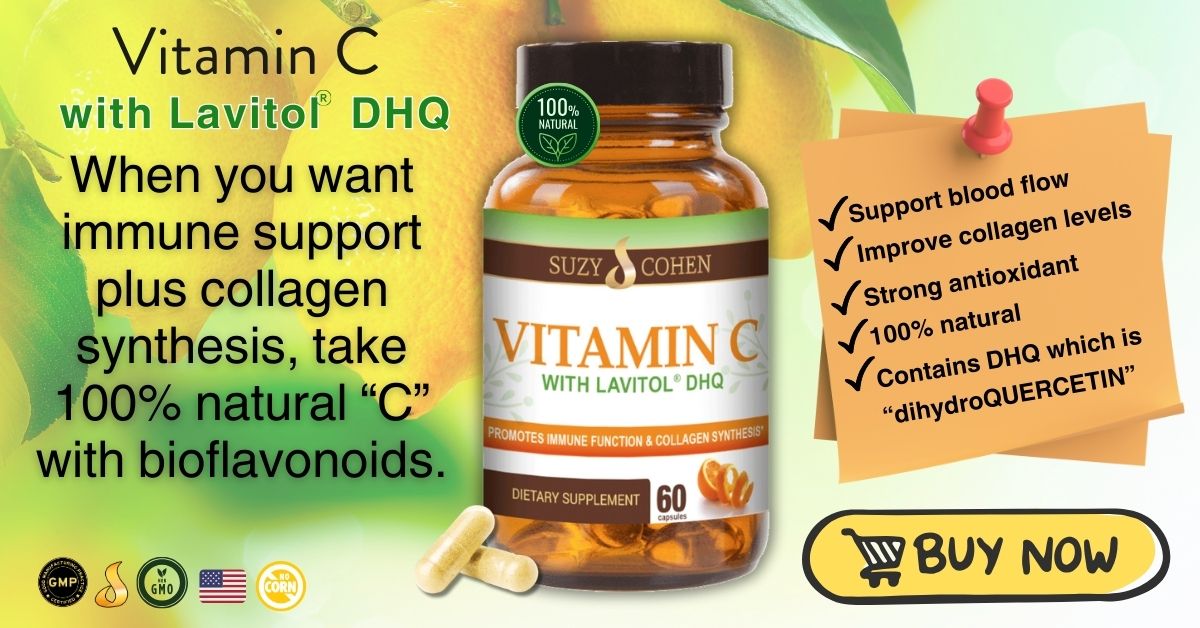
My formula provides vitamin C from natural acerola cherry extract rather than building the product around a giant megadose of isolated ascorbic acid.
A full two-capsule serving provides 250 mg of natural vitamin C along with 250 mg of natural citrus bioflavonoids complex and 20 mg of Lavitol® DHQ (dihydroquercetin), derived from the Dahurian larch tree. It’s 100% natural – all of it. Nothing from a laboratory.
I chose the moderate vitamin C dose deliberately. More isn’t automatically better, particularly when we’re talking about a nutrient whose absorption and blood concentrations the body already regulates remarkably well.
I also loved pairing the natural vitamin C with natural plant antioxidants instead of treating it like a soloist who fired the rest of the orchestra. That doesn’t make liposomal vitamin C bad. This isn’t a hit piece. If you take that and love it, by all means. Whatever works for your body.
I simply don’t believe that maximum absorption should automatically be the goal for C because higher blood levels don’t translate scientifically into anything useful IMHO.
Related Articles
Why You Should Think Twice Before Buying B Complex Vitamins
Vitamins – Are you getting a great deal on your vitamins, or a great deal of junk?
7 Natural Ways to Improve Eyesight
8 Reasons Why I Threw Out My Multivitamin
Clearing the Confusion About the Types of Collagen

Suzy Cohen, RPh, has been a licensed pharmacist for over 30 years, blending conventional medicine with natural approaches to help people feel better and live healthier. She is the founder of Script Essentials, a supplement company known for targeted, custom-formulated products, some with patented innovations.
With a special focus on thyroid health, functional medicine, and drug-induced nutrient depletion (what she calls “drug muggers”), Suzy is the author of several books including Thyroid Healthy, Drug Muggers, and Diabetes Without Drugs. She also writes a nationally syndicated health column and shares practical, easy-to-understand guidance with readers around the world.