If you’ve ever stared into the bathroom mirror and discovered a shiny new silver hair that definitely was not invited, you may have wondered what happened.
Did I suddenly age overnight?
Was it stress? My hormones? Something I’m missing nutritionally? Or did my hairdresser sneak it in there?
There’s some fascinating biochemistry behind gray hair, and one little enzyme called catalase has attracted quite a bit of attention. Catalase helps your body break down hydrogen peroxide, a reactive compound that your own cells naturally produce. Yeah, hydrogen peroxide. The same chemical you may have used years ago to disinfect a scraped knee is produced inside your body every day.
And here’s where things get interesting. Researchers studying gray and white hair have found hydrogen peroxide accumulation along with reduced activity of certain antioxidant enzymes, including catalase. That discovery raised an intriguing question:
Could our hair be turning gray partly because of an internal bleaching process?
Well, sort of. But the science is considerably more complicated than some supplement advertisements would have you believe. And that’s what I want to explain today.
Meet Catalase: Your Cellular Cleanup Crew
Catalase is an antioxidant enzyme found throughout your body, particularly in tiny structures inside your cells called peroxisomes. Think of peroxisomes as miniature cleanup crews that help break down certain fats and manage potentially harmful byproducts of metabolism.
One of their important jobs involves hydrogen peroxide.
Hydrogen peroxide (H₂O₂) isn’t inherently bad. Your cells produce it naturally, and in controlled amounts it even participates in cellular signaling. The trouble begins when excessive amounts accumulate and overwhelm the body’s protective systems.
That’s where catalase comes in.
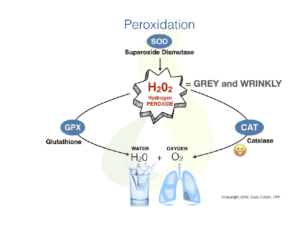
It rapidly converts hydrogen peroxide into water and oxygen. See image above.
2 H₂O₂ → 2 H₂O + O₂
In other words, catalase takes a potentially damaging substance and transforms it into two very ordinary things.
Water and oxygen. Talk about taking out the trash and recycling it!
Fun fact: Catalase is extraordinarily efficient. Under favorable laboratory conditions, a single catalase enzyme molecule can break down millions of hydrogen peroxide molecules per second.
You can even observe catalase activity using hydrogen peroxide and certain fresh biological tissues, such as liver. The bubbling represents oxygen being released as hydrogen peroxide breaks down. It’s a classic biochemistry demonstration, although I wouldn’t recommend experimenting with concentrated peroxide or treating the demonstration as a measure of what happens inside your hair follicles. Want to watch my VIDEO using liver and see what happens?
Now Let’s Talk About Gray Hair
Hair gets its color primarily from melanin, the pigment produced by specialized cells called melanocytes within the hair follicle.
As we age, pigment production gradually declines. The melanocyte stem cells that replenish pigment-producing cells may also become depleted or lose their ability to function normally.
Genetics plays a major role. That’s why one woman discovers her first gray hair at 28 while her friend is still smugly brunette at 58.
Not that we’re bitter. But genetics isn’t the entire story. Scientists have also investigated oxidative stress as a contributor to hair graying.
A fascinating 2009 study published in The FASEB Journal examined human gray and white hair and reported increased hydrogen peroxide accumulation alongside reduced expression of catalase and other protective enzymes. The researchers proposed that this oxidative environment could interfere with the biochemical machinery responsible for producing melanin.
One important enzyme in that process is tyrosinase, which helps manufacture pigment.
Here’s a simplified way to understand the proposed relationship:
Oxidative stress → hydrogen peroxide accumulation → disruption of pigment production → graying hair
But please notice the word simplified. Gray hair isn’t merely a catalase deficiency. Hair aging involves genetics, melanocyte stem cells, oxidative stress, mitochondrial function, environmental exposures, nutritional status, and ordinary aging. Your hair follicle is considerably more complicated than your bathroom drain. 
Are We Really Bleaching Our Hair From the Inside?
You’ve probably heard that hydrogen peroxide can bleach hair.
That’s true when it’s applied externally at sufficient concentrations. But inside the follicle, the situation is different.
The hydrogen peroxide theory of graying comes from legitimate biochemical observations. Researchers have identified oxidative changes in gray and white hair, including changes involving hydrogen peroxide and antioxidant defenses.
These findings suggest that oxidative stress may contribute to pigment loss. But I don’t want you picturing little bottles of Clairol peroxide hiding underneath your scalp.
Your body isn’t literally performing a salon bleaching treatment. The more accurate explanation is that excess oxidative stress may disrupt several processes necessary to maintain healthy pigment-producing cells and melanin synthesis. It’s an important distinction. Especially when somebody is trying to sell you something.
So Why Not Just Take Catalase?
Ah and that’s the million-dollar question. Once researchers connected reduced catalase activity with hydrogen peroxide accumulation in gray hair, supplement manufacturers became interested.
The reasoning sounded wonderfully straightforward: Gray hair has less catalase activity.
Catalase breaks down hydrogen peroxide. Therefore, take catalase and restore your original hair color. Except biology rarely respects a three-line marketing plan. Catalase is a protein enzyme. When swallowed, it encounters stomach acid and digestive enzymes that normally break down proteins.
That raises several important questions. How much supplemental catalase survives digestion in an active form? Does it reach circulation? Can it reach human hair follicles? And most importantly, does it actually change pigmentation?
Those are not small details. At present, convincing human clinical evidence has not established that taking oral catalase supplements reliably prevents or reverses ordinary gray hair. That doesn’t make catalase uninteresting. Quite the opposite. It means we need to distinguish a fascinating biochemical mechanism from a proven clinical outcome. I say this often about supplements: Something can make perfect biochemical sense on paper and still fail to produce the expected result in a human being.
Humans are terribly inconsiderate that way. 
The Catalase Gray-Hair Controversy
This deserves a little attention because the history is relevant.
In 2015, the Federal Trade Commission challenged marketers of certain catalase-containing supplements promoted for preventing or reversing gray hair.
The agency alleged that the advertised benefits were not supported by adequate scientific evidence. Subsequent enforcement activity reinforced the importance of substantiating these kinds of claims. The FTC’s actions did not establish that catalase has no biological role in hair pigmentation.
Catalase absolutely participates in normal antioxidant defense, and research has identified relationships among catalase, hydrogen peroxide, and hair graying. The problem was the much bigger commercial promise:
Take this supplement and your gray hair will return to its original color. That’s a different claim altogether.
And it requires appropriate human evidence. As a pharmacist, I find the underlying research genuinely interesting. But I also think consumers deserve to know when a product’s marketing has moved ahead of the science. A plausible mechanism isn’t the same thing as a proven benefit. Remember that the next time you see a spectacular supplement advertisement.
What About Catalase Supplements Today?
Catalase is sold as a dietary supplement, both alone and in combination formulas.
The enzyme itself has a well-established physiological role in helping cells manage hydrogen peroxide.
What remains uncertain is whether taking catalase orally produces meaningful changes in antioxidant activity inside human hair follicles. And whether those changes, if they occur, would translate into visible improvements in hair pigmentation.
We simply don’t have convincing clinical evidence establishing those outcomes. For that reason, I’d be skeptical of products claiming that oral catalase can eliminate gray hair, restore natural hair color, or reliably prevent graying.
Could future research uncover a useful application? Certainly.

That’s why scientists keep studying these pathways. But until good human trials establish a benefit, I wouldn’t buy a catalase supplement expecting my hair to turn brunette again.
If You’re Going Gray Early, Look Beyond Catalase
Gray hair that develops with normal aging is usually just that.
Normal aging.
Premature graying, however, can sometimes deserve a closer look.
Research has identified associations between early graying and certain nutritional or medical factors, including vitamin B12 status, folate, iron status, copper, vitamin D, and thyroid function. These findings vary across studies, and an association doesn’t necessarily mean a deficiency caused the gray hair.
Still, if someone experiences unusually early graying, particularly alongside fatigue, hair shedding, dietary restrictions, or other symptoms, I think it’s reasonable to discuss possible testing with a healthcare professional. Depending on the circumstances, that might include vitamin B12, folate, ferritin and iron studies, thyroid function, and selected additional nutrients.
I wouldn’t automatically order every test for every gray hair.
And I certainly wouldn’t recommend taking iron or copper without a good reason. Too much of certain minerals can create problems of its own.
Correcting a documented deficiency makes much more sense than blindly throwing supplements at your follicles and hoping somebody turns brunette. One more thing: Correcting a deficiency doesn’t guarantee that established gray hair will regain its original color.
I wish it were that simple.
Stress Really May Matter
You’ve probably heard someone say, “This job is turning my hair gray!”
Turns out that statement may contain more biology than we once thought.
Research in animals has demonstrated that certain stress pathways can influence pigment-producing stem cells. Small human studies have also explored relationships between psychological stress and changes in hair pigmentation.
Interesting? Absolutely.
Proof that one horrible Tuesday causes gray hair by Wednesday? Nope!
Hair follicles are influenced by numerous biological processes, and the relationship between emotional stress and human graying is still being investigated.
I also think we should be careful about blaming ourselves for physical changes that happen during difficult periods.
Stress is part of life. Sometimes it’s unavoidable. And hair color is certainly not a reliable measure of how well someone is managing it.
Catalase Has an Antioxidant Partner 
Here’s something fascinating that doesn’t get much attention.
Catalase doesn’t work alone.
Another antioxidant enzyme called superoxide dismutase (SOD) helps convert superoxide radicals into hydrogen peroxide.
Catalase and other peroxide-processing enzymes then help break that hydrogen peroxide down. It’s a beautiful example of teamwork inside your cells. Your antioxidant defense system is a network, not a single superhero.
Other important participants include glutathione peroxidase and various molecules involved in maintaining cellular redox balance. Now, before anyone gets too excited about combining supplements, I want to point out that the way these enzymes cooperate inside cells doesn’t prove that swallowing them together improves hair pigmentation.
That’s a separate scientific question. And one that deserves actual human research. Read this article to find out How Glutathione is Depleted from the Body.
Supporting Your Own Antioxidant Defenses
Rather than obsessing over one enzyme, I prefer looking at the bigger picture. Your body has an elaborate antioxidant defense system that depends on normal cellular function and adequate nutrition. A varied diet containing vegetables, berries, nuts, seeds, legumes, and other nutrient-rich foods helps provide the building blocks needed for overall health. Adequate protein matters too. After all, enzymes are proteins.
And then there are the decidedly unglamorous habits:
- Get adequate sleep.
- Exercise regularly. (Read my other article and find out how Exercise Improves Memory and Enhances Mood)
- Don’t smoke.
- Eat a balanced diet.
- Address nutritional deficiencies when they’re actually present.
- Find manageable ways to reduce chronic stress.
None of these habits has been proven to prevent ordinary age-related graying.
But they support health in ways that extend far beyond hair color. I realize that’s less exciting than discovering a secret anti-gray-hair molecule growing on a Himalayan mountaintop. But your mitochondria aren’t particularly impressed by marketing.
So, Does Catalase Keep You From Going Gray?
Here’s where I land on this.
Catalase plays an important role in normal antioxidant defense, and research has connected hydrogen peroxide accumulation with gray hair. But we do not have convincing human evidence that taking catalase supplements prevents or reverses graying.
Both statements can be true. That’s what makes this topic interesting.
The science of hair pigmentation continues to evolve, and researchers are investigating how oxidative stress, stem cells, genetics, and other pathways interact.
There may be more to discover. For now, I would focus on understanding the biology rather than expecting a capsule to change my hair color. And frankly, there’s something rather beautiful about silver hair anyway. Although I reserve the right to say that while simultaneously sitting in my colorist’s chair.
Final Thoughts
Catalase is one of those enzymes that reminds me why I still love biochemistry after all these years.
Our bodies constantly produce reactive compounds like hydrogen peroxide, while maintaining sophisticated systems to keep them under control. The gray-hair connection is fascinating because it offers one possible explanation for how oxidative changes contribute to the loss of pigment.
But fascinating science isn’t permission to make promises that haven’t been demonstrated in humans. That’s especially important in the supplement world.
Stay curious. Ask questions. And whenever you see the words “clinically proven to reverse gray hair,” ask to see the actual human clinical trial.
Not a testimonial.
Not a diagram of an enzyme.
The study. And if the evidence isn’t there, perhaps raise one beautifully silver eyebrow.
Related Articles
Make More Catalase It’s Good for Your Health
Catalase Neutralizes Peroxide and Offers 3 Healing Benefits
High PSA? 5 Smarter Tests Before a Biopsy
Liposomal Vitamin C vs. Regular Vitamin C: Which Is Better?
Are You Taking the Right Kind of Magnesium? Pros and Cons of 5 Popular Types
The Surprising Connection Between Stress, Immunity and a Cold

Suzy Cohen, RPh, has been a licensed pharmacist for over 30 years, blending conventional medicine with natural approaches to help people feel better and live healthier. She is the founder of Script Essentials, a supplement company known for targeted, custom-formulated products, some with patented innovations.
With a special focus on thyroid health, functional medicine, and drug-induced nutrient depletion (what she calls “drug muggers”), Suzy is the author of several books including Thyroid Healthy, Drug Muggers, and Diabetes Without Drugs. She also writes a nationally syndicated health column and shares practical, easy-to-understand guidance with readers around the world.