Eight weeks ago, I lost my son Michael unexpectedly, and violently. (Here’s the original STORY since I can’t say the words anymore).
Since then, I’ve learned something about grief that textbooks can’t fully convey. Grief isn’t confined to your thoughts. You can feel it in your stomach, your sleep, your muscles, your breathing – and sometimes in the pounding or fluttering of your heart.
As a pharmacist, that made me curious: Can you actually have a broken heart?
Because trust me, if feels like you CAN!
There is a real medical condition called Takotsubo syndrome, also known as stress cardiomyopathy or Broken Heart Syndrome (BHS). Intense emotional or physical stress can temporarily weaken the heart muscle, making it less able to contract normally and pump blood effectively.
And this is on top of you feeling sad, anxious, apathetic or overwhelmed.
The cardiac changes can actually be seen on an echocardiogram, alter your ejection fraction, affect an ECG, raise cardiac biomarkers and, occasionally, trigger dangerous heart rhythms. Simply put, emotional stress can sometimes cause real, measurable changes in how your heart functions.
FYI, ejection fraction (EF) is a measure of how well your heart pumps blood. Look at your labs, generally, it should be 50% or higher.
So let’s talk about what happens when emotional stress makes its way all the way to the heart. 
1. What Exactly Is “Broken Heart Syndrome”?
Takotsubo syndrome is a temporary form of heart-muscle dysfunction that can appear suddenly, often following intense emotional or physical stress.
Bereavement is one possible trigger, but certainly not the only one. Other reported triggers include tremendous fear, anger, arguments, accidents, surgery, serious illness and other major physical stressors. Interestingly, sometimes there is no identifiable trigger at all.
The syndrome predominantly affects women, especially older, postmenopausal women.
Researchers still don’t completely understand why it happens. One main explanation involves an extreme activation of the sympathetic nervous system (that’s your fight-or-flight system), and an abnormal response to stress hormones called catecholamines, particularly adrenaline and noradrenaline.
Incidentally, these are the same chemicals, just different names.
- Adrenaline = epinephrine
- Noradrenaline = norepinephrine
Think of it as the heart becoming temporarily stunned rather than permanently destroyed.The changes that occur in the heart should go back to their baseline after a while.
2. Why Is Broken Heart Syndrome Called Takotsubo?
The name comes from Japan.
A takotsubo is a traditional Japanese pot used to trap octopus. In the classic form of Broken Heart Syndrome, the apex (tip) of the heart’s main pumping chamber balloons outward while other portions contract differently. See the image below. 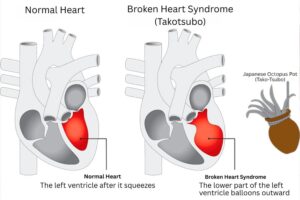
See the resemblance? On an echocardiogram or cardiac MRI (CMR), the left ventricle can take on a shape resembling that unusual octopus pot!
Not everyone develops this classic “apical ballooning” pattern. There are mid-ventricular, basal and focal forms too. It’s getting over my head now, so you’ll have to ask your cardiologist for more on those forms. 😊
The point is, you can’t self-diagnose Broken Heart Syndrome just because something devastating happened and suddenly your heart feels funky, skips a beat, or you develop chest pain. Takotsubo produces specific changes in how the heart functions, and doctors need cardiac testing to figure out what’s actually going on.
3. Your Ejection Fraction (EF) Can Drop
Ejection fraction (EF) tells us how well your heart is pumping. More specifically, it measures the percentage of blood inside the left ventricle that gets pushed out with each heartbeat. A normal EF is generally about 50 to 70 percent.
During Takotsubo syndrome, portions of the heart muscle temporarily stop contracting normally. As a result, the heart can’t squeeze as effectively, less blood gets pushed out with each beat, and the EF can fall, sometimes substantially.
That’s real cardiac dysfunction.
The good news is that as the stunned heart muscle recovers, EF often improves too. This is one important way classic Takotsubo differs from many chronic causes of reduced EF.
But I don’t want you assuming that emotional stress explains every declining EF.
Grief itself does not automatically lower your ejection fraction. Someone with coronary artery disease, significant valve disease, persistent arrhythmias or another form of cardiomyopathy needs those conditions evaluated on their own merits. Speaking of arrhythmias, you may be interested in this article next: Irregular Heartbeat? It Could Be AFib (Atrial Fibrillation)
Broken Heart Syndrome is a specific diagnosis—not a convenient explanation for every abnormal heart test that happens during a stressful period.
4. Your Echocardiogram Can Change Too
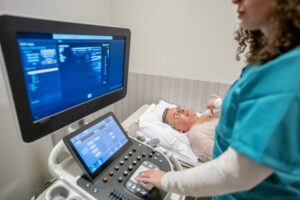
An echocardiogram allows doctors to watch the heart contracting in real time.
During acute Takotsubo syndrome, an echo may reveal the characteristic regional abnormalities in heart-muscle movement. It may also show a reduced EF.
In some people, Takotsubo can temporarily produce or worsen mitral regurgitation, meaning some blood leaks backward through the mitral valve. Other complications visible on imaging can include obstruction of blood leaving the left ventricle, involvement of the right ventricle and, occasionally, formation of a blood clot inside a poorly contracting portion of the heart.
Here’s an important distinction:
Takotsubo doesn’t merely make an echocardiogram falsely look abnormal. The echo is recording a heart that really is functioning abnormally at that moment.
As the heart recovers, those findings can improve. 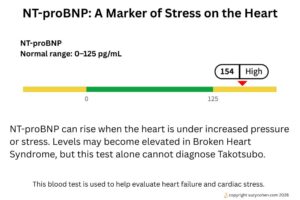
5. Broken Heart Syndrome Can Present Just Like a Heart Attack!
This is perhaps the most important thing I can tell you.
Someone with Takotsubo may experience:
- Chest pain or pressure
- Shortness of breath
- Palpitations
- Fainting or near-fainting
- Weakness or sudden distress
An ECG may also become abnormal. The ST-segment changes, T-wave inversions and prolongation of the QT interval can occur. Some of these findings can look remarkably similar to those of an acute heart attack. Even troponin, the blood marker doctors frequently use to detect heart-muscle injury, is often elevated. You can measure your troponin with a blood test.
Another cardiac marker called BNP or NT-proBNP (also measured with a simple blood test) which rises when the heart is under significant stress, may become quite elevated as well.
This is why you should never sit at home with chest pain after a terrible emotional event and decide, “It’s probably just stress.”
Doctors have to rule out a heart attack and other potentially dangerous conditions. 
6. What About Arrhythmias?
Yes, these can happen too.
Takotsubo can alter the electrical behavior of the heart. Some people develop atrial arrhythmias, while potentially serious ventricular arrhythmias can occur in a smaller proportion of patients.
The QT interval may also become prolonged. That’s important because excessive QT prolongation can predispose susceptible people to dangerous ventricular rhythms.
But here’s another distinction worth remembering:
Stress can cause palpitations without causing Broken Heart Syndrome.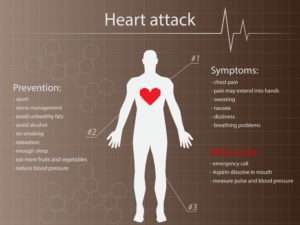
Adrenaline can make your heart pound. Anxiety can increase your pulse. Sleep deprivation, dehydration, caffeine, alcohol, thyroid abnormalities, medications and electrolyte disturbances can all contribute to palpitations.
Feeling your heart flutter during grief does not mean you have Takotsubo.
7. How Do Doctors Know It’s Broken Heart Syndrome?
This part is fascinating because Broken Heart Syndrome can look so much like a heart attack at first.
Doctors may use an ECG, blood tests, an echocardiogram and heart imaging and monitoring to actually figure out what’s going on. The whole time you might think you’re going to die! Remember, chest pain plus an abnormal ECG ane/or possibly elevated troponin can’t simply be blamed on stress. A heart attack has to be considered and ruled out appropriately.
Cardiac MRI, also called CMR for “cardiovascular magnetic resonance,” can be particularly helpful in some cases. It will show how the heart muscle is contracting, measure ejection fraction (EF) and look for changes within your heart muscle itself. It can also help them determine whether it’s Takotsubo or some other condition, like a heart attack or myocarditis.
One clue is that Takotsubo can weaken the heart in a pattern that doesn’t look like the damage caused by one blocked coronary artery, which helps doctors distinguish it from a typical heart attack. But you don’t need to remember all of that. Here’s the important part:

You can’t diagnose Broken Heart Syndrome from the heartbreak. You diagnose it from the heart.
8. Does the Heart Recover?
Thankfully, in most people, heart function does recover.
That’s one of the remarkable things about Takotsubo. The heart muscle may be dramatically weakened during the acute episode, yet the abnormal contraction and reduced ejection fraction are usually reversible. Recovery often occurs over days to several weeks, although everyone is different.
But don’t let the word “temporary” make this condition sound harmless.
During the acute period, Broken Heart Syndrome can cause heart failure, significant arrhythmias, very low blood pressure and, occasionally, blood clots inside the heart. In severe cases, cardiogenic shock can occur, and although uncommon, Takotsubo can be fatal.
It can also happen again. So this is a real cardiomyopathy that deserves real medical attention—even though the heart often recovers beautifully.
9. Why Women Should Know About This
This part really caught my attention.
Broken Heart Syndrome predominantly affects women, particularly older, postmenopausal women.
Scientists still don’t completely understand why. Estrogen may be part of the story because it appears to influence blood vessels, the nervous system and the way the cardiovascular system responds to stress hormones. But the biology is complicated, and I don’t want to reduce this to “low estrogen causes Broken Heart Syndrome.” We simply don’t know that.
Still, if you’re a woman in your 50s, 60s or 70s going through tremendous emotional or physical stress, Takotsubo deserves a little space in your mental filing cabinet. Not so you’ll worry about it. So you’ll recognize it.
10. What Can You Do Naturally?
I wish I could tell you there was a particular vitamin that prevents Broken Heart Syndrome. There isn’t.
And there’s no supplement I’d recommend as a treatment for an acute episode of Takotsubo. That’s hospital territory.
But taking care of your cardiovascular system and nervous system during prolonged periods of stress certainly makes sense.
Try to sleep as well as circumstances allow. Eat regularly, even when you don’t feel like it. Stay hydrated. Keep moving if you’re able, even if it’s just a walk outside. Be careful about excessive alcohol, and don’t try to live on caffeine and adrenaline. Your heart has enough going on.
MAGNESIUM is important for normal cardiac electrical activity, but it isn’t a treatment for Takotsubo. The same goes for omega-3 fatty acids, CoQ10 and other heart-supportive nutrients like Vitamin C, D, E, K and pomegranates. Some of these things may certainly have cardiovascular benefits for appropriate people, but I don’t want anyone thinking a handful of supplements can prevent or treat a failing or “broken” heart.
Let’s also fail to underestimate things that help quiet an overstimulated nervous system:
 Prayer, meditation, yoga, slow breathing, time outdoors, grief support and simply being around people you love aren’t silly little wellness suggestions. Your brain, nervous system and heart are communicating with one another all day long! Make every minute count before it’s gone.
Sometimes the most natural medicine available is simply allowing another person to sit beside you while you’re hurting.
One Last Thought
I’ve learned over these past seven weeks that grief has a physical presence.
It can mess with your sleep. It can steal your appetite. It can exhaust you and somehow leave you wired at the same time. And your heart may suddenly pound because a song comes on, you see a picture, or you hear a helicopter overhead airlifting some other unlucky soul.
That doesn’t mean you’re developing Broken Heart Syndrome.
And before you start checking your pulse every five minutes, please don’t. Most palpitations during stressful times are not Takotsubo.
The point I’m trying to make is that the connection between your emotions, nervous system and heart is very real. We tend to put emotional health in one little box and physical health in another, but your body doesn’t necessarily work that way.
So don’t panic over every flutter.
But don’t dismiss your heart either. If you develop new chest pain or pressure, significant shortness of breath, fainting or other sudden concerning heart symptoms, please seek medical attention.
You don’t have to figure out whether it’s anxiety, a heart attack or a broken heart. That’s what doctors are for.
Related Articles
7 Nutrient Deficiencies That Can Feel Like Something Is Wrong With Your Heart
Coffee Lovers, Take Heart: The AHA Has Good News
Can Vitamin C Replace Statins? 3 Potential Benefits for Cardiovascular Health
5 Hidden Links Between Hiatal Hernia, GERD & Shortness of Breath – and Solutions
7 Natural Ways to Manage Cholesterol: Beyond Oreos
Palliative Care: You Don’t Have to Be Dying to Deserve Comfort

Suzy Cohen, RPh, has been a licensed pharmacist for over 30 years, blending conventional medicine with natural approaches to help people feel better and live healthier. She is the founder of Script Essentials, a supplement company known for targeted, custom-formulated products, some with patented innovations.
With a special focus on thyroid health, functional medicine, and drug-induced nutrient depletion (what she calls “drug muggers”), Suzy is the author of several books including Thyroid Healthy, Drug Muggers, and Diabetes Without Drugs. She also writes a nationally syndicated health column and shares practical, easy-to-understand guidance with readers around the world.