Why Am I Itching All Over? 9 Causes That Have Nothing to Do With Allergies
Have you ever been sitting on the couch, minding your own business, when suddenly your arms start itching? Then your legs. Then your scalp. Before you know it, you’re scratching like you’ve rolled around in poison ivy, except there’s no rash, no bug bite, and no obvious explanation.
What gives?
As a pharmacist, I can tell you that unexplained itching is more common than you might think. And while most people immediately blame allergies, there are plenty of other possibilities.
Your liver, kidneys, thyroid, nerves, medications, and even certain nutrient deficiencies can trigger itching. Sometimes your skin looks perfectly normal, which makes the whole thing even more frustrating.
The medical term for itching is pruritus (pronounced proo-RYE-tus). But whatever you call it, when you’re itching all over, you want answers.
Let’s look at nine possible culprits, including a few that might surprise you. 
1. Your Medications May Be Making You Itch
This is one of my favorite topics because medications can create symptoms that you may never connect to your prescription.
In my book Drug Muggers, I discuss how medications can affect the body’s nutritional balance. But medications can also cause itching directly, sometimes without a visible rash.
Here are some common medication categories worth investigating:
One interesting example is codeine, oxycodone, or hydrocodone. Itching after taking codeine doesn’t automatically mean you’re allergic. Opioids can activate itch-signaling pathways directly and that comes as a big surprise to users because they’re usually expecting constipation or nausea instead.
And here’s something else to consider: A medication doesn’t have to be brand-new to be worth investigating. Reactions in the human body can occasionally develop after you’ve been taking something for a while, even years! Shocking, I know.
So review everything you’re taking, including prescriptions, over-the-counter medications, vitamins, and herbal products. Don’t stop an important medication on your own, but do ask your local pharmacist or google whether itching is a recognized, and well-documented side effect.
2. Your Liver or Gallbladder is Impaired
Your liver does much more than process medications and filter substances from your bloodstream. It also produces bile, which helps digest fats.
When bile flow becomes impaired, a condition called cholestasis can develop. One of its most frustrating symptoms is itching, sometimes severe itching.
Here’s what makes liver-related itching interesting, it’s that you may have absolutely no rash. None at all. Which makes me think of psychogenic rashes (but that’s not what I’m talking about here). One day I’ll devote an entire article to psychogenic itching (where the skin can itch intensely without a visible rash). It’s a fascinating brain-skin connection that deserves a little more research on my part, so stay tuned for that. Back to livers/gallbladders.
This type of itching can affect your entire body, although the palms and soles are sometimes particularly bothersome. It may also become worse at night. By the way, itching of the palms can occur during or after IVIG (intravenous immunoglobulin) infusions in case you get that treatment for SMALL FIBER NEUROPATHY or some other immune condition.
Possible underlying causes include bile duct obstruction, primary biliary cholangitis, certain medications, and other liver diseases.
Scientists now believe that multiple chemical messengers contribute to what they call “cholestatic itching,” including a signaling molecule called lysophosphatidic acid.
It’s not simply a matter of bile salts irritating your skin.
What to ask your doctor: Consider liver blood tests, including alkaline phosphatase, bilirubin, ALT, and AST. Depending on the results, additional testing may be appropriate.
If itching comes with yellow eyes, darker than normal urine, pale stools, or any kind of abdominal pain (even mild), then don’t dismiss it as just dry skin. See a doctor to determine if the underlying cause is your liver or gallbladder.
3. Your Kidneys Aren’t Filtering Waste Efficiently
Kidney-related itching is another overlooked possibility and it’s much more common than people think. Those with advanced chronic kidney disease (CKD) sometimes experience persistent itching that can affect their back, arms, legs, or entire body.
The condition is called CKD-associated pruritus in case you want to look it up.
Scientists believe it involves several overlapping factors, including inflammation, altered nerve signaling, and changes in the body’s internal chemical balance.
This isn’t usually a symptom of mildly reduced kidney function. It’s much more common in advanced kidney disease, especially among people receiving dialysis.
If you have risk factors you’re more likely to develop this type of itch. Things such as diabetes, HYPERTENSION, or known kidney disease, it’s worth considering. Read this article to find out how to turn off your DIABETES OFF-SWITCH.
Helpful tests: Creatinine, estimated glomerular filtration rate (eGFR), and a urine albumin test can help assess kidney health.
And please don’t assume a detox tea will cure kidney-related itching. Some herbal cleanses are fine, but not curative. Others can actually be harmful to people with kidney disease. Do your research thoroughly before taking anything.
4. Your Thyroid May Be Out of Balance 
Both an underactive thyroid (hypothyroidism) and an overactive thyroid (hyperthyroidism) can contribute to itching.
With hypothyroidism, the skin often becomes dry, rough, and flaky because skin turnover and sweat gland activity can slow down.
Hyperthyroidism (the opposite of hypo) can increase warmth, sweating, and skin sensitivity, sometimes causing a lot of itching.
If you’re also experiencing fatigue, constipation, hair thinning, cold intolerance, palpitations, or unexplained weight changes, your thyroid deserves a closer look. I’ve written extensively on this topic so make THIS ARTICLE the next one you read if you have itching, and you’re tired/gaining weight.
My pharmacist tip: Get a full thyroid profile blood test, and even reverse T3 which can provide additional information for someone who is out of thyroid balance. Don’t assume every itch is a histamine problem requiring an antihistamine because sometimes the underlying issue is hormonal.
5. You’re Low in Vitamins or Minerals
Here’s one that surprises people: Iron deficiency can sometimes cause generalized itching, even before significant anemia develops.
Iron plays a role in oxygen transport and normal cellular function. The precise connection between low iron and itching isn’t completely understood, but the association is well recognized.
Other nutritional concerns may include vitamin B12 deficiency, particularly when nerve symptoms are present.
Vitamin D status may also be relevant in selected patients with chronic itching, although the research is mixed and supplementation isn’t a proven cure.
And here’s where my drug muggers philosophy comes into play. Click on the link below to see what nutrients are drained from your body if you take a certain drug. All medications can interfere with nutrient absorption or metabolism to some degree over time, some worse than others. For example, long-term metformin use can lower vitamin B12 levels in some people. That’s because metformin is a drug mugger of B12.

Helpful tests: A complete blood count, ferritin, and iron studies are reasonable starting points. Vitamin B12 testing may be useful if you also have tingling, numbness, or risk factors for deficiency.
Please don’t start high-dose iron simply because you’re itching. Too much iron can be harmful.
6. Your Blood Sugar May Be Running High
Diabetes can affect your skin in several ways.
Elevated blood sugar can contribute to dehydration, dry skin, and increased susceptibility to fungal infections. Over time, diabetes may also damage small nerves, producing unusual sensations, including itching.
Some people describe the sensation as crawling, prickling, burning, or itching beneath the skin. You might notice itching in particular areas rather than everywhere, but generalized itching can occur.
If you’re thirsty all the time, urinating more frequently, experiencing blurry vision, or dealing with recurrent yeast infections, consider having your blood sugar checked.
What to test: Fasting glucose and hemoglobin A1c. If you’ve had diabetes for more than 10-15 years, you may want to do a punch biopsy test for SMALL FIBER NEUROPATHY too.
One caveat: Mildly elevated blood sugar isn’t automatically the explanation for itching. It’s one piece of the puzzle but if you’re blood sugar is routinely high the odds become more likely.

7. Your Nerves May Be Sending False Alarm Signals
Not all itching begins in the skin.
Sometimes the nervous system itself generates the sensation. This is called neuropathic itch, and it can occur with peripheral neuropathy, shingles, nerve compression, or certain neurological conditions.
Unlike ordinary itching, neuropathic itching may feel like tiny electrical sparks, pins and needles, burning, or insects crawling across the skin.
It often affects a specific area, such as the upper back, arms, or scalp, rather than the entire body.
One example is notalgia paresthetica, which causes persistent itching around the shoulder blade. Another is brachioradial pruritus, which often affects the forearms and may be associated with cervical spine problems.
And here’s the frustrating part: Antihistamines may do very little to nothing because histamine isn’t driving the problem!
If you have itching along with numbness, tingling, burning, or neck and back problems, mention those symptoms to your healthcare provider.
8. Food Dyes and Additives May Be Triggering Your Skin
Before you throw away everything in your pantry, let me explain.
Food additive sensitivity is real, but it’s much less common than social media might lead you to believe. Some reactions are immune-mediated, while others occur through nonallergic pathways.
In susceptible people, certain additives have been associated with itching, flushing, or hives.
Here are several worth knowing about:
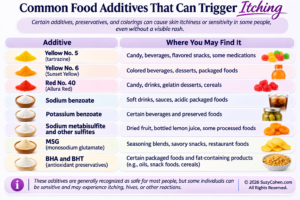
A little scientific perspective is important here. Tartrazine, sulfites, and benzoates have documented associations with hypersensitivity-type reactions in some people. For other additives, including Red No. 40, Yellow No. 6, MSG, BHA, and BHT, evidence specifically linking them to generalized itching is weaker or inconsistent.
These substances are not established causes of itching for most people.
My suggestion: If you suspect a food additive, keep a simple food-and-symptom diary for two weeks. Record what you eat, when itching begins, and whether a rash appears. Look for repeatable patterns instead of eliminating 25 foods at once.
Also, don’t overlook dyes and inactive ingredients in medications and supplements. The ingredient that bothers you may not be the active drug.
If you experience swelling, wheezing, or widespread hives after eating, seek medical advice rather than attempting an elimination-and-rechallenge experiment on your own.
9. Stress, Hormones, and Dry Skin May Be Working Together
As we age, our skin produces less sebum (natural oil) and loses moisture more easily, weakening its protective barrier. For women, menopause adds another layer as declining estrogen contributes to collagen loss and changes in skin lipids, including ceramides, making dryness and itching more likely. Stress can worsen things by activating cortisol and adrenaline pathways and influencing itch-related chemicals like substance P, which can stimulate sensory nerves. Scratching then triggers more inflammation, creating the notorious itch-scratch cycle. It’s a biochemical vicious circle, and your skin is caught in the middle!
I always encourage people to look at the whole picture. Are you sleeping poorly? Taking long, hot showers? Living in a dry climate? Using fragranced laundry detergent? Experiencing hormonal changes associated with menopause or age-related testosterone decline (sometimes called andropause)?
Sometimes several small irritants join forces to create one big, itchy problem!
My natural approach: Take lukewarm showers, apply a rich, fragrance-free moisturizer while your skin is still slightly damp, and consider colloidal oatmeal baths for temporary relief. Your skin needs a little TLC, not another reason to scratch!
One caution: Essential oils aren’t necessarily gentle just because they’re natural. Tea tree, peppermint, and lavender oils can irritate sensitive skin, especially when applied undiluted or on raw skin so use caution and dilute with carrier oils or avoid altogether until more healing occurs. 
What About Itching That Happens at Night?
Nighttime itching deserves special attention because it can rob you of sleep.
Your body temperature, skin moisture, and natural inflammatory rhythms change throughout the day. Some people notice that itching becomes more intense when they climb into bed.
Nighttime itching can occur with dry skin, eczema, medication reactions, kidney or liver conditions, and other problems.
And here’s another possibility: Scabies, a mite infestation, often causes intense nighttime itching. It’s not an allergy, and the rash may initially be subtle. Other household members may start itching, too.
If you’re itching mainly at night, especially between your fingers, around your wrists, or along your waistline, ask your healthcare provider whether scabies should be ruled out.
Could Itching Be a Sign of Something Serious?

It’s a fair question if it’s been going on for years without explanation. So my answer is Yes, but only occasionally.
Persistent, unexplained itching can accompany certain blood disorders polycythemia vera, and, less commonly, lymphoma.
One unusual clue is itching triggered by water, even when the water isn’t hot. This is called aquagenic pruritus
https://my.clevelandclinic.org/health/diseases/22516-aquagenic-pruritus
and can occur with polycythemia vera, although many people with water-triggered itching do not have that condition.
Itching accompanied by unexplained weight loss, drenching night sweats, fever, or swollen lymph nodes deserves prompt medical evaluation.
I’m not sharing this to scare you. Most itching isn’t caused by cancer. But persistent generalized itching without a rash shouldn’t automatically be dismissed.
Which Blood Tests Should You Ask For?
If you’re itching all over and nobody can figure out why, consider discussing a basic laboratory evaluation with your healthcare provider. 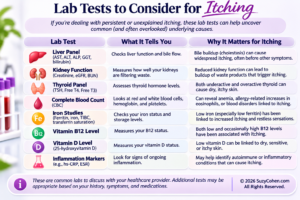
Depending on your symptoms, your provider may recommend additional testing, including imaging or evaluation for skin conditions.
These tests are not all necessary for everyone, but CBC, iron studies, kidney and liver function, thyroid testing, and glucose evaluation are common starting points for persistent unexplained itching.
I probably don’t need to say this: Get emergency care for itching accompanied by difficulty breathing, throat or tongue swelling, or faintness – also if it occurs with any blistering or peeling skin, fever with a widespread rash, or jaundice. Persistent itching that disrupts sleep or lasts more than a couple of weeks deserves a medical appointment, even without a rash.
Final Thoughts
Here’s what I want you to remember: Itching is a symptom, not a diagnosis.
Sometimes the answer is as simple as dry skin or a medication side effect. Other times, it’s a clue pointing toward your thyroid, liver, kidneys, blood sugar, or nervous system. I especially encourage you to look at your med list before assuming you need some other cream, more hydrocortisone, another oatmeal bath or a different antihistamine.
And if your skin looks perfectly normal but you can’t stop scratching, get some help. Your skin is sending a message. The goal is to figure out what it’s saying, rather than just silencing the itch.
Wishing you good health and a whole lot less scratching!
Related Articles
10 Quick Ways to Relieve Itchy Red Eyes
10 Novel Treatments for Chronic Itch, Eczema and Skin Infections
Shingles Pain: 17 Excellent Idea to Heal and Recover Faster
I Used to Be Allergic to Cats. Then I Met Willow
8 Strategies to Reduce Histamine and Ease Hashimoto’s & Autoimmune Disorders
9 Lifestyle and Dietary Tweaks for Allergy Relief Strategies

Suzy Cohen, RPh, has been a licensed pharmacist for over 30 years, blending conventional medicine with natural approaches to help people feel better and live healthier. She is the founder of Script Essentials, a supplement company known for targeted, custom-formulated products, some with patented innovations.
With a special focus on thyroid health, functional medicine, and drug-induced nutrient depletion (what she calls “drug muggers”), Suzy is the author of several books including Thyroid Healthy, Drug Muggers, and Diabetes Without Drugs. She also writes a nationally syndicated health column and shares practical, easy-to-understand guidance with readers around the world.